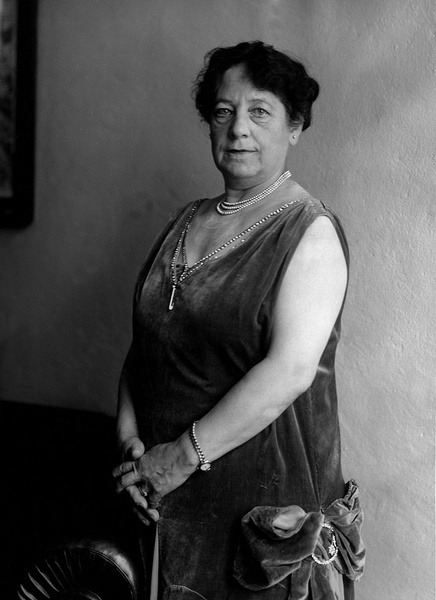


Born to a merchant on June 10, 1865, in Budapest, Therese Rothauser initially received vocal training in her hometown with Emmerich Bellovicz and later in Berlin with Gustav Schmidt. She was brought to the Leipzig Opera in 1887 as a concert singer and went to
the Königliche Hofoper in Berlin two years later, where she remained for 25 years. Following a performance of Bizet’s Carmen, in which Rothauser sang the title role, she was honored by Emperor Wilhelm II, who presented her with a valuable brooch. She eventually retired from the stage and, from 1914 on, worked as a voice teacher in Berlin.
Therese Rothauser’s stage career had already ended nearly 20 years before the Nazis came to power, and so she was spared from the wave of dismissals that immediately followed. However, the ongoing disenfranchisement of the Jewish population and the ever increasing woes of persecution befell her too. Though General Director Heinz Tietjen delivered “the great, loyal, and seasoned artist” a message through the distinguished opera singer Fritz Soot wishing her a happy 75th birthday on behalf of the State Opera, the opera house reduced her already meager pension less than a year later. While this posed a severe threat to her livelihood, her numerous personal and written requests to reverse the measure were denied.
Upon learning in December of 1941 that she and her sister, Katalin Rothauser, were to be deported, Rothauser appealed to Hermann Göring as “patron of the Staatliche Bühnen”. “My 77-and-a-half-year-old sister and myself, 76 and a half years of age, face the fate of our fellow Jews and are to be forced from the place we as native Hungarians have chosen as our second fatherland on our own accord, having become citizens out of loyalty and allegiance.”
But help never came: Therese and Katalin Rothauser were deported to the Theresienstadt concentration camp on August 21, 1942. According to a woman who witnessed the deportation, the singer “told the Gestapo officers there to take her away that she wanted to bid her piano farewell. She sat at the piano, a large image of the emperor hanging on the wall behind her, and on the other side the two Gestapo officers stood at attention with their hats removed. She then sang the song Teure Heimat, lebe wohl.”
Therese Rothauser succumbed to the conditions at Theresienstadt on April 20, 1943. Her sister did not survive her imprisonment either: Katalin Rothauser died on May 19, 1944.
1865 Budapest
1943 Theresienstadt (Concentration Camp)