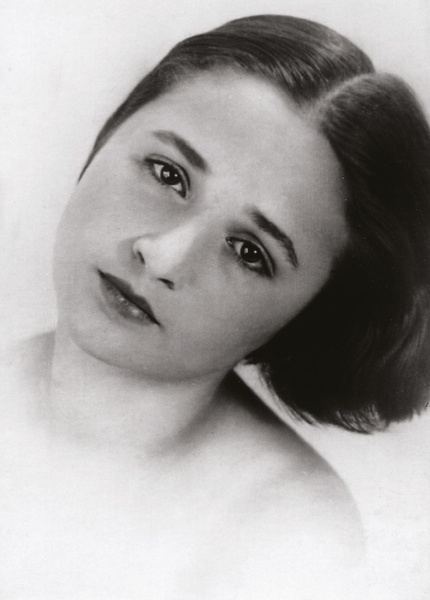


The daughter of Jewish parents, Suse Rosen was born Susanne Rosenthal on March 7, 1910, in Dresden. All that is known about her training is that she was a student of Lina Gerzer in 1924/25, the first solo dancer of the Deutsche Oper in Berlin. When Gerzer was appointed ballet master at the Stuttgart Landestheater in 1927, she secured an engagement for the 17-year-old Rosen. Ballet was not its own discipline at the time, but instead typically accompanied operas and operettas. By 1929 she had received rave reviews for her performances in Hugo Herrmann’s chamber opera Gazellenhorn and comic opera Fatme. From then on, she was given solo roles in major productions, such as Mozart’s The Marriage of Figaro; Offenbach’s Orpheus in the Underworld and La belle Hélène; and Verdi’s Aida, in which she performed the sword dance. In her review, Lina Gerzer emphasized the young soloist’s “extraordinary artistic capabilities”, and Stuttgart general director Albert Kehm later described her as “an extraordinarily gifted and thus highly appreciated dancer.” Rosen also performed in minor theatrical roles and ran a ballet school for children. Indeed, it seemed as though Rosen had a great career to look forward to—until Hitler came to power and crushed all hope.
The NS-Kurier, the local Nazi Party newspaper, was an early antagonist of the young dancer: “The content of the operetta Das Lied der Liebe,” the critic Erich Maier-Stehle wrote in November of 1932, “is Jewish bedroom poetry with the lewdest of songs. The role of the hotel maid Tini ... was portrayed by the Jewish solo dancer Suse Rosen. Rosen’s repugnant acting and unspectacular dancing were just what the writer and the chosen audience wanted.”
Six months later, on May 15, 1933, Rose received her notice of termination from the Stuttgart Ministry of Education and the Arts, which was to take effect at the end of the season. She initially sought refuge with her mother in Berlin, but decided to leave Germany in late 1933 and set out to find work as a cabaret dancer in Belgium, Holland, Luxembourg, and Italy. Unable to secure employment, she found herself sick and destitute and in 1934 was taken in by friends in Switzerland and later in Italy. Through a marriage of convenience, she was able to obtain Swiss citizenship in 1936, sparing her from deportation. In 1938, she picked up her search for employment as a dancer in Switzerland, but was unsuccessful. Now the mother of a daughter, Rosen worked as a barkeeper until she collapsed from cardiac neurosis in 1943, having learned that her mother and sister had been murdered at the Bergen-Belsen concentration camp.
After recuperating, she returned to working the strenuous night shift but was barely able to make ends meet, and so in 1955 she emigrated to the United States on her relatives’ invitation and earned a meager living as a housekeeper in New York. Only in 1963 was her desire to return to Europe fulfilled, when the State of Baden-Württemberg granted her restitution after eight years of legal and bureaucratic hurdles. Suse Rosen died on February 4, 1968, in Locarno.
1910 Dresden
1968 Locarno