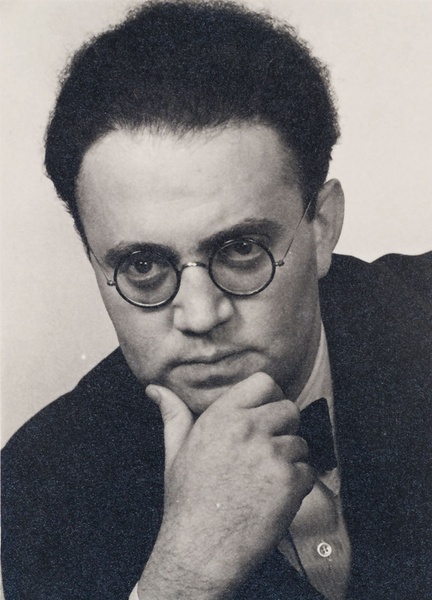
Born to Jewish parents on March 17, 1895, in Dortmund, Sally Urias, known as Siegfried, began his career in 1916 as an actor on unusual stages: the Millowitsch Theater in Cologne and the front theater of the 3rd Army. From 1920 to 1926, he worked at the Bonn Stadttheater, followed by a year in Cologne. Alongside these engagements, he studied singing at the local music academy with a scholarship from Cologne mayor Konrad Adenauer. After his first engagements at the opera houses in Münster and Duisburg/Bochum, he was hired as a bass-baritone at the Hessian Landestheater Darmstadt for the 1932/33 season.
There, he sang the title role in Eugene Onegin and The Flying Dutchman, Scarpia in Tosca, Alfio in Cavalleria rusticana, and Don Pizarro in Fidelio. While the theater critic of the Darmstädter Tagblatt, following the premiere of Eugene Onegin, credited his voice with “a beautiful middle register” and praised his expression and performance as “effective”, the review of his first role in a Wagner opera revealed a clearly recognizable anti-Semitic pattern, claiming that Urias treated his unquestionably present “beautiful, resonant” vocal material “intellectually, coldly, and without soul.” His performance, the review continued, worked “through external means … not from within” and could not “fully capture the mysticism and demonic qualities of the Dutchman’s character.” After his debuts in Tosca and Cavalleria rusticana, a verdict was reached: the singer was suited only for use “in non-German opera.” The new Nazi authorities went even further. Because of his Jewish origins, they banished Siegfried Urias from German theaters entirely. On March 31, 1933, he was placed on leave, and on June 3 his dismissal followed under the newly enacted “Law for the Restoration of the Professional Civil Service”.
Urias married Johanna Bragard in November of 1933, and in 1934 the couple moved to Berlin. There, he became one of the most important soloists of the Jewish Cultural Federation, the only opportunity the Nazis had left to displaced Jewish artists to practice their professions. Until the opera ensemble was dissolved in May of 1939, he sang all the major roles there. On June 29, he was arrested and imprisoned at the Dachau concentration camp, among other places. His non-Jewish wife succeeded in securing his release after one year and was also able to save him from the deportations that began in 1941. Thereafter, he was subjected to four years of grueling forced labor at cement and construction companies in Berlin.
After his liberation on April 30, 1945, Siegfried Urias returned to the theater in Bonn. However, because his voice had suffered as a result of the hardships he had endured, he could not initially be employed as a singer. In 1954, after being certified by a physician as “one hundred percent unfit for work,” he was forced to give up his profession permanently. Only five years, after a tedious process, did he manage to obtain compensation, securing him a dignified life. After his wife’s death, Siegfried Urias moved to the Jewish nursing home in his native city of Dortmund. He died there on January 12, 1971.
1895 Dortmund
1971 Dortmund