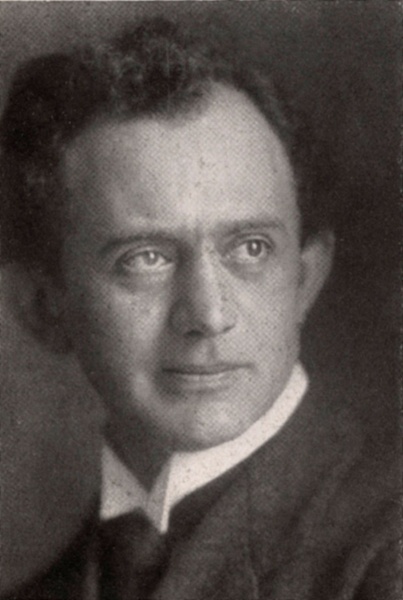


Siegfried Lewinsky was born on May 24, 1881, in Kempen, Prussia (present-day Kępno, Poland). After completing an apprenticeship, he initially worked as a merchant. With the help of a scholarship, he began taking acting lessons in Berlin in the following years. He made his stage debut in 1901 at the Wesel Stadttheater and later moved to a stage in Stettin. However, the low pay was not enough to live on, and he was forced to return to work in commerce. In 1910, he renewed his efforts and auditioned at the Königliches Schauspielhaus in Dresden. His audition was a success, and he remained an ensemble member for nearly 25 years. There he mainly played supporting roles, including in Friedrich Hebbel’s Die Nibelungen; in Shakespeare’s Henry IV, Troilus and Cressida, and The Merchant of Venice; and in George Bernard Shaw’s Saint Joan.
As a Jew, Siegfried Lewinsky’s career was brought to an end when the Nazis came to power in 1933. Because his status as a long-standing ensemble member made it difficult to terminate his employment, the theater management placed the 53-year-old into retirement effective August 31, 1934. He remained in Dresden and, without any more career prospects, lived on a modest pension. His “privileged mixed marriage” to a non-Jewish wife initially offered some degree of protection from persecution. However, this protection proved ineffective when anti-Semitic hatred erupted in pogroms on November 9/10, 1938. As a so-called “Aktionsjude” (action Jew), he was arrested and imprisoned at the Buchenwald concentration camp from November 13 to December 14, 1938, after which he returned to Dresden.
After the outbreak of war, the situation of Jews in the Reich became increasingly perilous. While his “mixed marriage” offered protection from the deportations that began in 1942, it did not protect him from forced labor. In February of 1941, Lewinsky was subjected to two years of forced labor at Zeiss Ikon, followed by another two years at a Dresden cardboard factory.
On February 13, 1945, he was ordered to prepare for deportation on February 16 for forced labor elsewhere. That same evening, his friend Victor Klemperer met him and other Jews awaiting deportation in a so-called “Jewish house” on Zeughausstraße.
The air raids on Dresden that began that night—killing up to 25,000 people—became their only chance of survival: “Just a few hours later, Dresden was bombed. That was our good fortune; for when we gathered … early at Zeughausplatz, we saw the burning heap of ruins. The Gestapo, who would certainly have taken us to one of the notorious camps, was not there.”
Lewinsky survived the final weeks of the war. In July of 1945, he was re-engaged as an actor at the Interimstheater, which became the Staatsschauspiel. He retired in 1950 but continued to appear as a guest actor until 1953. Siegfried Lewinsky died on February 20, 1958, in Dresden.
1881 Kepno (Kempen)
1958 Dresden