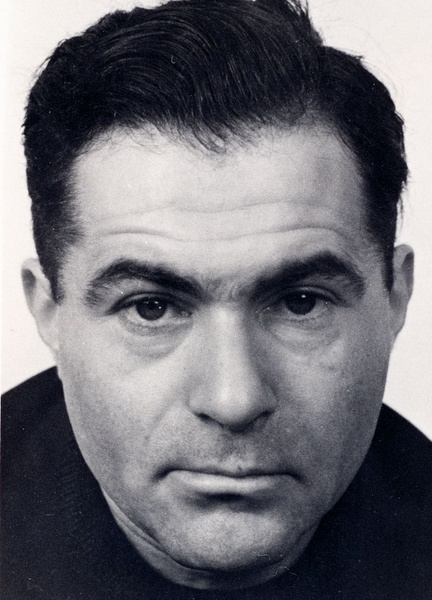
Born on January 14, 1897, in Tilsit (present-day Sovetsk, Russia) as the son of a banker, Siegfried Sebba joined the military as a volunteer in 1914 and served as a soldier in World War I. After a few semesters studying chemistry and physics, he changed fields and completed an artistic education at the Königsberg Academy of Art. He subsequently worked as a freelance artist during the 1920s and early 1930s, traveled to Asia and Scandinavia, and accompanied the prominent ethnologist Leo Frobenius as a draftsman on an expedition to the region of present-day Egypt. He also worked on a temporary basis at the state theaters in Munich and Berlin.
Sebba had little theater experience when General Director Gustav Hartung brought him to the Hessian Landestheater Darmstadt as a set designer in August of 1932. Nevertheless, the artist created highly praised sets there for ten productions, including Wilhelm Schmidtbonn’s Der verlorene Sohn, Sigmund Graff’s Die unendliche Straße, and most significantly André Gide’s Oedipe.
Because Sebba was Jewish, the Nazis’ seizure of power brought his work in Germany to an end. On March 31, 1933, he was placed on leave, and on June 3 he was permanently dismissed. By that time, however, he had already left Darmstadt, fleeing first to Basel via Berlin and then, in 1934, emigrating further to Sweden via Denmark. In 1936, he left the continent and settled in Palestine. There, he worked as a photographer and craftsman and as a set designer at the theater in Tel Aviv. While his paintings were confiscated from public art collections in Germany and destroyed in 1937, he won first prize at the New Bezalel School of Arts and Crafts in Jerusalem, today’s Bezalel Academy of Arts and Design, that same year. In the 1940s, he enjoyed renewed success as a painter and sculptor whose monumental frescoes and murals shaped public buildings in the newly founded State of Israel. His 1947 painting Shearing remains one of the most prominent works of art of the Jewish state to this day.
In 1967, Sebba returned to Germany and, with the support of his friend, the painter and art dealer Hanna Bekker vom Rath, moved to Hofheim am Taunus. Despite his declining health, he remained artistically productive during the final years of his life. Siegfried Shalom Sebba died on February 12, 1975, in Hofheim am Taunus.
1897 Tilsit
1975 Hofheim am Taunus