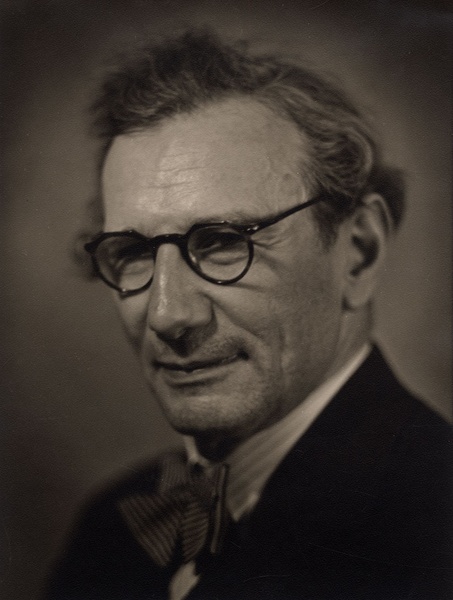


Richard Engländer was born on February 17, 1889, in Leipzig. He studied piano, organ, cello, composition, and musicology in Leipzig and Berlin, as well as musicology, German studies, and history in Leipzig, Berlin, and Bonn, completing his studies in 1916 with a doctorate in music history. In 1919, after serving as a soldier in World War I, he began working in Dresden as a pianist, music director, conductor, music teacher, and writer. From 1922 to 1926, he was a répétiteur at the Semperoper and assistant to Chief Music Director Fritz Busch. In 1926, he became a lecturer in music history at the orchestra school of the Staatskapelle, where many Semperoper musicians had been training young talent since 1923.
Engländer’s career in Germany was brought to an end when the Nazis came to power. As a Jew, he was suddenly deemed unfit “to interpret the music of Richard Wagner and Mozart.” Although he was initially protected from dismissal as a World War I front-line veteran, that protection no longer applied by August of 1935, and he was dismissed “with immediate effect.”
He initially remained in Dresden, working as a private music teacher. But after repeated interrogations and an arrest in 1939 made the situation life-threatening, he fled to Sweden in May of 1939, completely destitute. There, he succeeded in building a new career. He worked as a music teacher, gave lectures, and from 1948 taught at Uppsala University as well as Aarhus University in Denmark. He also became active as a composer and musicologist. Richard Engländer died on March 16, 1966, in Uppsala.
1889 Leipzig
1966 Uppsala