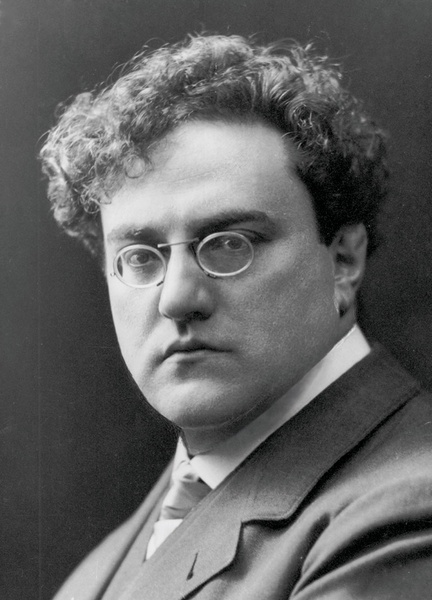


The son of a merchant from Bohemian Reichenberg (present-day Liberec, Czech Republic), Richard Breitenfeld worked at as a manager at a factory before receiving vocal training in Vienna and making his debut at the Cologne Opera in 1897 as Count di Luna in Il trovatore. In 1902 the baritone went to the Frankfurt Opera and was apparently cast as Klingsor in a production of Parsifal at the Bayreuth Festival, though for unknown reasons he did not perform.
Breitenfeld remained in the ensemble of the Frankfurt Opera for 24 years in addition to holding numerous guest engagements in Germany and abroad. In Amsterdam, he sang the role of Amfortas in a 1905 production of Parsifal, which the Bayreuth Festival directorate attempted to shut down, and later appeared as Wolfram in Tannhäuser. In Zurich, he sang the role of Kurwenal in a 1917 production of Tristan and Isolde. He also made regular guest appearances at opera houses throughout Germany and made a name for himself as a concert singer and especially as a performer of the lieder of Hans Pfitzner.
As a Jew, Breitenfeld had been subjected to anti-Semitic hostilities since at least the 1920s. This culminated in systematic persecution when the Nazis came to power in 1933. Retired since 1926, Breitenfeld was prohibited from performing not just at the opera, but also with the Jewish Cultural Federation—or else he risked losing his pension. He and his wife Olga lived under rapidly deteriorating living conditions in the years that followed and, in August of 1942, received notice of their pending deportation. Now 72 years old, a distraught Breitenfeld wrote to his former employer: “I am writing to inform you that, today, after 39 years of service at the Frankfurt Opera, my wife and I are being taken away with the other Jews (to Theresienstadt?). What will happen to my pension?” Upon being informed by the city’s administrative office that Breitenfeld would be “collected by the Gestapo” that day or the following day at the latest, and that his apartment had already been vacated, the opera’s directorate gave the following instructions to accounting: “The aforementioned informed us on August 29, 1942, that he and his wife were to be taken away that day as part of a Jewish deportation campaign. I request that you stop the payment of pension benefits.”
On September 1, 1942, two were sent from Frankfurt to the Theresienstadt concentration camp on train number Da 509, Transport XII/2. Olga Breitenfeld died there on October 8, 1942, and Richard Breitenfeld too succumbed to the torture on December 16, 1942.
1869 Liberec
1942 Theresienstadt (Concentration Camp)