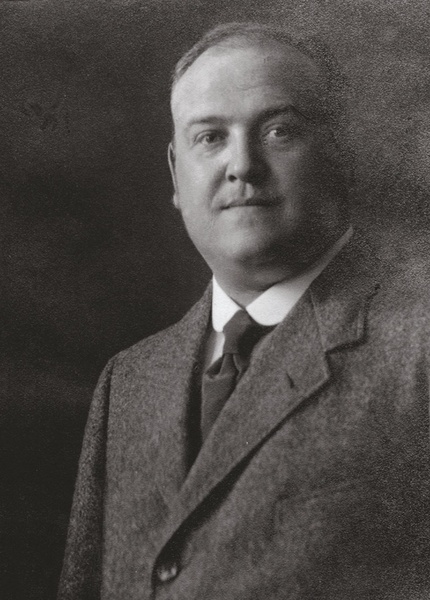


Bass singer Reinhold Fritz was born on March 16, 1884, in the village of Ruit auf den Fildern—now part of Ostfildern—the son of a lathe operator. He initially trained and worked as a goldsmith in Esslingen, but in 1904 he also began studying voice in Stuttgart. In 1907 he joined the Stuttgart Hoftheater as a student, and a year later he was awarded a five-year contract. Fritz rapidly established himself as one of the company’s leading bass singers. With an extraordinarily extensive repertoire of principal and secondary roles, he performed up to 130 times a year in a schedule that featured a different work almost every day. His artistic versatility was remarkable: he sang not only serious and comic roles, but also parts typically associated with the heroic baritone repertoire. His roles included Sarastro in The Magic Flute, Osmin in The Abduction from the Seraglio, Rocco in Fidelio, Caspar in Der Freischütz, Cardinal Johann von Brogny in La Juive, and Ramfis in Aida. In the operas of Richard Wagner, he appeared as Veit Pogner in Die Meistersinger von Nürnberg, Gurnemanz in Parsifal, King Marke in Tristan und Isolde, and Daland in The Flying Dutchman, as well as Fafner, Hunding, and Hagen in the Ring cycle. Fritz also took part in several premieres in Stuttgart, including Walter Braunfels’s Prinzessin Brambilla in 1909, Siegfried Wagner’s An allem ist Hütchen schuld in 1917, and Paul Hindemith’s Das Nusch-Nuschi in 1921. Despite guest appearances in Munich and Karlsruhe and offers from other opera houses, he remained a loyal member of the Stuttgart Opera ensemble throughout his career. His achievements brought official recognition as well. In 1914, the King of Bavaria awarded him the Gold Medal for Art and Science. In 1916, he received Württemberg’s Charlotte Cross, and in 1917 he was appointed Royal Chamber Singer.
The Nazis’ seizure of power in 1933 brought his career to an abrupt end. The reason was that his wife, Hilda Landauer, was of Jewish descent. As a result, Fritz was forced into retirement on August 1, 1933. Just two days before his dismissal, he gave his final performance as Stefano Colonna in Wagner’s Rienzi on the outdoor stage of the opera house. By the time of his official farewell performance on December 6, 1933, in the role of van Bett in Albert Lortzing’s Zar und Zimmermann, he was already listed in the program merely as a “guest artist”. On that same day, in a largely symbolic gesture, the theater named him an honorary member.
A handful of later guest appearances in Stuttgart could not change the fact that his singing career had been cut short at its very peak. His expulsion from the Reich Theater Chamber in 1935 effectively barred him from the profession, since membership was required in order to work as a singer. Faced with a meager pension and mounting financial hardship, Fritz was forced to take jobs as a laborer, first with a coal merchant in Stuttgart and later with a company in Bielefeld. The family’s difficulties were compounded when their Stuttgart apartment was destroyed in an air raid during the war. After the end of World War II, the chamber singer returned briefly to the stage, appearing as a guest artist in ten performances with the Stuttgart Opera during the 1945/46 season. He spent his final years in Eningen unter Achalm, where he died on October 30, 1950.
1884 Ruit auf den Fildern
1950 Eningen unter Achalm