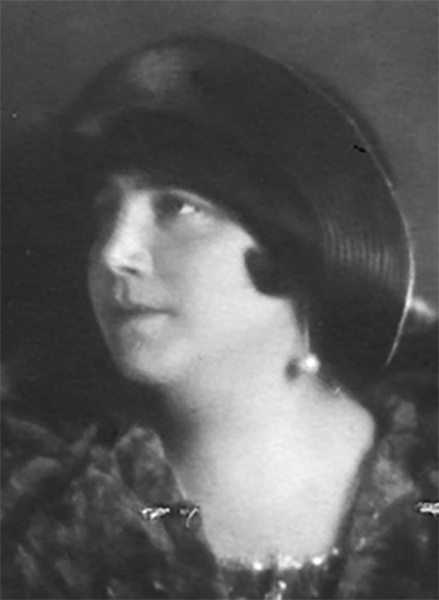


Minnie (born Minna) Ruske-Leopold was born to the horse trader David Leopold and his wife Betty in the Hessian town of Nidda, Germany, as the youngest of their six daughters. She received her musical training in Berlin under the soprano Emmy Burg-Raabe before joining the ensemble of the Nuremberg Stadttheater, where she still performed under her maiden name, Minnie Leopold. She then performed at the Heidelberg Stadttheater for one season, followed by a decade as an ensemble member of the Großherzogliches Hof- und Nationaltheater in Mannheim from 1914 until 1924. After an engagement at the Berlin Städtische Oper during the 1925/26 season, the singer shifted her focus to her career as a guest performer, which brought her to the Berlin State Opera, the Dresden Semperoper, and the Grand Théâtre in Geneva, as well as to Amsterdam and in 1927 and 1928 to the Bayreuth Festival. In December of 1921, she married the publisher Karl Ruske and subsequently went by Ruske-Leopold.
As a Jew, the singer’s career in Germany came to an end when the Nazis came to power in 1933. Five years later, Ruske-Leopold resolved to go into exile and on October 7, 1938, boarded the SS Bremen in Cherbourg, France. The ship operated a regular service between Bremerhaven and New York and at the time transported countless individuals seeking refuge from Nazi persecution. She reached New York on October 12, 1938.
Ruske-Leopold apparently struggled to continue her career in the United States and performed only occasionally at events organized by immigrants. No details are known about the course of her later life.
1891 Nidda