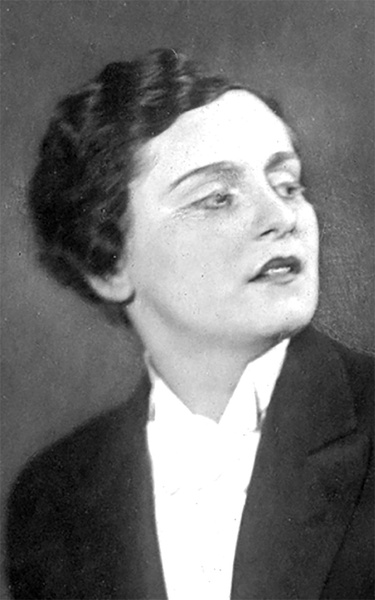


Born in what is now the Czech Republic, Maria Nezadal first studied voice at the Prague Conservatory and made her stage debut in 1924 in Olmütz (present-day Olomouc). Engagements at Vienna’s Volksoper in 1925 and the Bern Stadttheater in 1926 led to her appointment to the Bavarian State Opera in Munich in 1927. She had been recommended to the company’s general director, Clemens von Franckenstein, as “the strongest talent ... to emerge in recent years,” and he subsequently engaged the promising soprano. Nezadal’s repertoire included such roles as Aida, Carmen, and Santuzza, but she was especially acclaimed for her Wagnerian roles. She sang Freia and Woglinde in Das Rheingold, Elisabeth and Venus in Tannhäuser, Sieglinde and Ortlinde in Die Walküre, Senta in The Flying Dutchman, and Elsa in Lohengrin. She also appeared regularly at Covent Garden in London and guest-performed at the state operas in Vienna and Dresden, as well as at opera houses in Amsterdam and Prague. In 1927, she was invited to perform at the Bayreuth Festival.
As a Czech national, Nezadal had already become the target of nationalist and racist hostility before 1933, along with other foreign artists employed by the Munich Opera. Following the Nazis’ seizure of power, that hostility culminated in her dismissal. Despite earlier assurances, her contract was not renewed by Bavarian minister of education and the arts and gauleiter Hans Schemm. The opera administration expressed its regret in elaborate terms, assuring her “that we all deeply regret your premature departure from Munich, and that this unfortunate separation could only occur under the pressure of circumstances.” Yet the outcome remained unchanged: Nezadal was fired.
Her foreign citizenship was compounded by a second perceived liability. Since 1933, she had been married to Munich’s general director, Clemens von Franckenstein. On April 1, 1934, the long-serving conservative theater administrator was forced into retirement by the Nazi authorities to make room for a party loyalist. As a foreigner and the wife of a man removed for political reasons, Nezadal’s career in Germany effectively came to an end. A guest appearance scheduled for July of 1934 at the Dresden State Opera was “not approved by the supervising authorities at the last moment for certain reasons.” Efforts to secure a position at the Vienna State Opera likewise proved unsuccessful. As a result, she joined the Basel Stadttheater for the 1933/34 season and, after a lengthy interruption, did not return to the stage until the 1939/40 season, when she appeared at the Innsbruck Stadttheater. After the Second World War, Nezadal returned to Munich as a guest artist in 1948. She died on November 16, 1967, in Hechendorf, Upper Bavaria.
1897 Pardubice
1967 Hechendorf