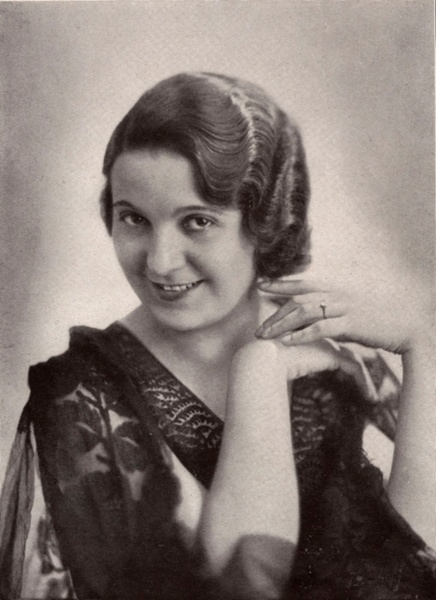


Margit Bokor, born Margit Wahl on April 2, 1900, in the Czech town of Lučenec—then part of Hungary—studied singing in Budapest and Vienna. In 1928, she made her debut in the title role of Beethoven’s Fidelio. On August 1, 1930, she joined the ensemble of the Semperoper, where she quickly achieved major success. Her roles included the Bridesmaid in Carl Marie von Weber’s Der Freischütz, Leonora in Giuseppe Verdi’s Il Trovatore, Micaëla in Georges Bizet’s Carmen, Venus in Richard Wagner’s Tannhäuser, Irene in Rienzi, and Rosalinde in Johann Strauss’s Die Fledermaus. She also appeared as Féodora in the premiere of Richard Heuberger’s Der Opernball, as Sora in Carl Millöcker’s Gasparone, and as Frasquita in Erwin Dressel’s Die Zwillingsesel. Critics praised the “sensuous timbre of her voice” and her “distinct dramatic talent” and went as far as to say that “one is inclined to believe that an exceptional career lies ahead.”
Because Bokor was Jewish, her promising career in Germany came to an end in 1933 after the Nazis came to power. Although she, too, signed the ensemble’s resolution against Chief Music Director Fritz Busch, who had been dismissed by the Nazis, she was still allowed to appear in the world premiere of Richard Strauss’s opera Arabella on July 1, 1933—likely because no adequate replacement could be found so quickly. However, her contract was allowed to expire on July 31, 1933. Bokor then left Germany and, in the autumn of that year, accepted an engagement at the Vienna State Opera, where she remained an ensemble member until 1938. In Vienna, she appeared in 1934 in the world premiere of Franz Lehár’s operetta Giuditta and Franz Salmhofer’s opera Die Dame im Traum. Alongside her work in Vienna, she became a regular guest at the Salzburg Festival beginning in 1934, performing roles such as Octavian in Richard Strauss’s Der Rosenkavalier and Cherubino in Mozart’s The Marriage of Figaro. The singer also achieved international success, appearing in 1934 at Covent Garden Opera in London, in 1938 at the Grand Opéra in Paris, and on stages in Italy and the Netherlands.
The annexation of Austria by Germany in March of 1938 once again put Margit Bokor in danger. On March 23, just days after Hitler proclaimed the Anschluss of Austria in Vienna on March 15, 1938, she was placed on leave by the State Opera’s management. On June 2, 1938, she was informed that “the continuation of the employment contract concluded with [her] no longer appears possible to the National Socialist state.” Her employment was therefore terminated “with immediate effect.”
Bokor initially fled to Paris. After appearances at the Grand Opéra, as well as in Amsterdam and Brussels, she left Europe and went into exile in the United States via Buenos Aires, arriving on October 27, 1939, aboard the cargo ship SS Mormachawk. She was accompanied by her husband, the Vienna-born impresario Paul A. Goldstein, who in the following years rose to become managing director of the US–Austrian Chamber of Commerce.
Margit Bokor succeeded in picking up her career again in the United States. In 1939, she performed in St. Louis in Ruggero Leoncavallo’s Pagliacci. In 1940, she appeared in Chicago and Philadelphia in Richard Strauss’s Ariadne auf Naxos and in the title role of Verdi’s La Traviata. She also gave guest performances in San Francisco and at the Metropolitan Opera in New York. In 1947, she joined the ensemble of the New York City Opera. Margit Bokor died on November 9, 1949, in New York after a serious illness. In her memory, Columbia University established the “Margit Bokor Memorial Fund”, which in the following years supported cancer research.
1900 Lučenec
1949 New York