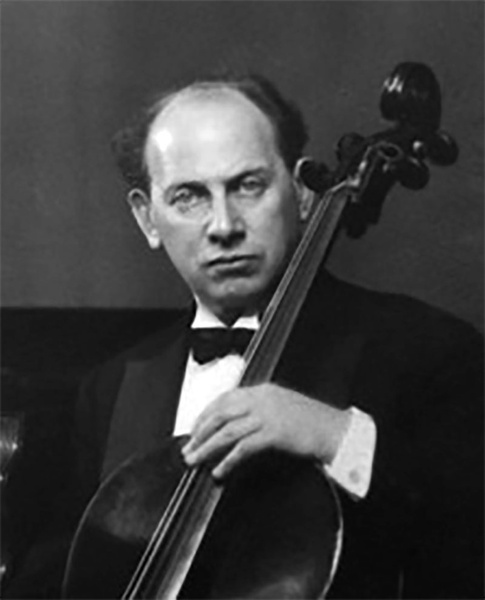


The cellist Lucian Horwitz was born on August 12, 1879, in Vienna. Little is known about the early stages of his career. As a member of the Berlin Philharmonic, he appeared in 1902 at a concert in Vienna’s Toynbee Hall featuring works by Ignaz Brüll. He later returned to Vienna, and by 1914 he was a member of the Vienna Tonkünstler Orchestra. Having become an acclaimed cellist, he appeared as a soloist in numerous concerts. After the First World War, he joined the ensemble of the Vienna Symphony Orchestra while continuing to perform as a solo cellist. In this capacity he also gave several concerts with Hermine Kittel, a Bayreuth soloist and sister of Carl Kittel, a long-serving member of the Bayreuth Festival administration. It may have been through this connection that he came to the attention of those responsible for the Wagner Festival, and in 1924 his name was placed on a reserve list for the festival orchestra. However, the conductor Karl Muck, who was responsible for assembling the orchestra, had marked Horwitz’s name with a swastika—apparently a code indicating that the Jewish cellist was not to be engaged under any circumstances. As a result, Horwitz never performed in the Bayreuth Festival Orchestra.
He continued to appear with the Vienna Symphony Orchestra at least until March of 1927. No information has been found concerning his life during the period that followed until the late 1930s. Following Germany’s annexation of Austria, Horwitz became subject to Nazi persecution and, on September 24, 1942, was deported to the Theresienstadt concentration camp. Even there, he remained musically active. He led an ensemble of prisoners that he himself had organized and, above all, served as a mentor to the younger musicians among the internees. On October 28, 1944, Lucian Horwitz was deported on the final transport from Theresienstadt to the Auschwitz-Birkenau concentration camp, where he was murdered.
1879 Vienna
1944 Auschwitz (Concentration and Extermination Camp)