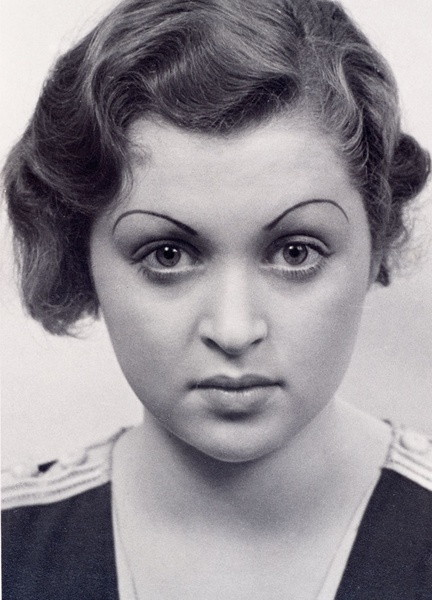
Born on May 24, 1914, in Posen as the daughter of a physician and an actress, Lilli Palmer grew up in Berlin, where she trained as an actress under Ilka Grüning, Lucie Höflich, and Else Schreiber. She made her stage debut in August of 1932 at Berlin’s Rose Theater and, later that same month, was engaged under a two-year contract by the Hessian Landestheater Darmstadt. There, audiences saw her in roles such as Ottilie in Ralph Benatzky’s The White Horse Inn, Raka in Paul Abraham’s operetta The Flower of Hawaii, and Monika Brink in Eduard Künneke’s Glückliche Reise.
The Nazis’ seizure of power brought Lilli Palmer’s stage career to an end. Because of her Jewish background, she was initially placed on immediate leave effective March 31, 1933, but was reinstated on April 22. On June 30, 1933, she was dismissed permanently.
Later that same year, she fled to Paris with her sister Irene, where the two performed in nightclubs and cabarets as the song-and-dance duo “Les Sœurs Viennoises”. In 1934, Lilli Palmer emigrated to London and began a career in film. In 1935, she played the female lead in the crime film Crime Unlimited. A year later, she appeared in a supporting role in Alfred Hitchcock’s Secret Agent. Her breakthrough as a film star came in 1937, when starred in the hit British film The Great Barrier.
Palmer married the prominent actor Rex Harrison in 1943 and moved to Hollywood in 1945, where she enjoyed success in such films as Fritz Lang’s Cloak and Dagger and Robert Rossen’s Academy Award-winning Body and Soul.
In 1954, Palmer returned to Germany, where she became one of the leading stars of postwar cinema while simultaneously advancing her international career. Over the following years, she appeared alongside Curd Jürgens and Romy Schneider, Clark Gable, William Holden, and James Mason, earning numerous awards and honors. In the course of the 1970s, she also established herself as a writer and painter. Lilli Palmer died on January 27, 1986, in Los Angeles.
1914 Poznań
1986 Los Angeles