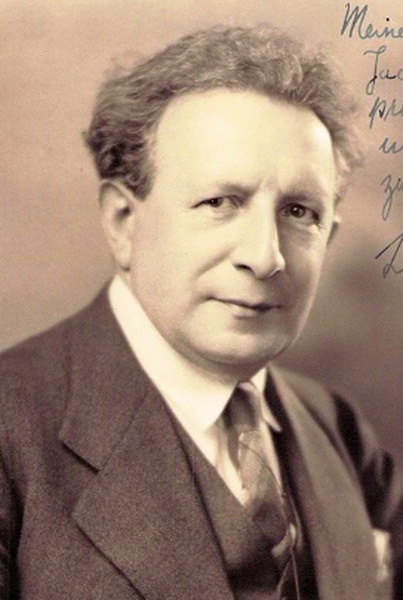


Leopold Sachse was born on January 5, 1880, in Berlin. After training as a singer, actor, and director in Cologne, Milan, Berlin, and Vienna, he made his debut in 1899 at the Schiller Theater in Berlin. After an engagement at the Barmen Stadttheater in 1901, he went to Strasbourg as a bass in 1902 and then to Plauen in 1903. In 1904 he moved to Kiel and in 1903 to Würzburg. In 1907 he was appointed general director in Münster, and from 1914 to 1919 he led the Stadttheater in Halle, where he garnered attention for his contemporary pieces and modern takes on Wagner’s operas. In 1922 he moved to Hamburg, where he was named general director of the Stadttheater, the present-day State Opera.
There, Sachse continued to champion contemporary composers. Under his leadership, works like Ferruccio Busoni’s Doktor Faust and Leoš Janáček’s Jenůfa had their place on the Hamburg stage alongside works like Ernst Krenek’s hit opera Jonny spielt auf, Hans Pfitzner’s Palestrina, Richard Strauss’s Die ägyptische Helena, and Igor Stravinsky’s Histoire du soldat.
For the German National and National Socialist press, however, this course was a symptom of the downfall of what they perceived to be “German” culture and would ultimately lead the Stadttheater “into cultural decadence and excessive foreign influence of the presence.” The political right—and the National Socialists in particular—saw General Director Sachse and his chief music director Egon Pollak as the driving forces behind this. Meanwhile, both the editorial staff and the readership were keenly aware that both were Jews.
“We considered—and still consider—it intolerable for a Jew to lead a German opera stage, skills or no skills,” the local Nazi newspaper lamented in June of 1931. It went on: “From a folkloric and cultural–psychological perspective, determining how German opera culture is reflected in Hebraic minds is of great interest. However, we have had ample opportunities to do this in Hamburg and have wasted enough of the taxpayers’ money already. Make way for German art!” One month later, in July of 1931, Sachse was demoted to senior director. In March of 1933, shortly after the Nazis came to power, he was placed on leave and subsequently forced into retirement.
The artist then became active in the Jewish Cultural Federation. He went into exile in 1935, first in France and then in New York, where he staged nine Wagner operas at the Metropolitan Opera by March of 1936, including the Ring cycle. Back in Germany, his house on Hamburger Oberstraße was expropriated and his assets confiscated by the Reichsbank. Meanwhile, the artist remained in New York, where he continued to work at the Met as well as internationally as a sought-after guest director in addition to teaching at institutions such as the Juilliard School of Music and the Academy of Vocal Arts in Philadelphia. As vice president of the American Guild of Musical Artists, he founded a relief fund to support the Hamburg State Opera after the war. Leopold Sachse died on April 3, 1961, in Englewood Cliffs, New Jersey.
1880 Berlin
1961 Englewood Cliffs