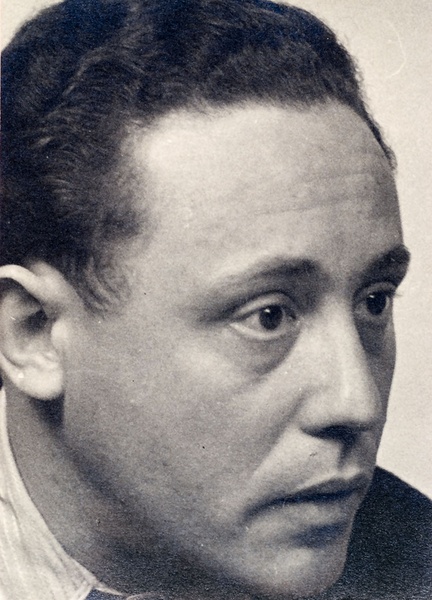
Born into a Jewish family on March 10, 1902, in Lehrte, Lower Saxony, Kurt Hirschfeld studied philosophy, German literature, and art history in Heidelberg before working for the Berliner Börsen-Courier and in radio broadcasting. In 1931, the general director of the Hessian Landestheater Darmstadt, Gustav Hartung, appointed him dramaturge in Darmstadt because, as Hartung wrote to the then just 29-year-old Hirschfeld, he was “not an established figure,” but someone Hartung trusted and was “determined to help succeed.”
The young dramaturge transformed the Blätter des Hessischen Landestheaters into a leading theater journal, brought writers such as André Gide to Darmstadt, and introduced groundbreaking works such as Bertolt Brecht’s Saint Joan of the Stockyards to the theater’s repertoire. During his second season, he also earned outstanding reviews as a director, including for productions of Franz Werfel’s Juarez and Maximilian and Hans Rehfisch’s Razzia. Alongside the general director, Hirschfeld had become the defining figure at the Hessian Landestheater Darmstadt. It therefore came as no surprise that he, too, was forced out on March 13, 1933, together with Hartung.
Hirschfeld subsequently left Darmstadt and found refuge in the Berlin apartment of his colleague Wilhelm Reinking. His uncertain situation came to an end in early May, when Hartung invited him to join him at the Schauspielhaus Zürich. Hirschfeld used his position there to bring other displaced theater workers to Zurich, including the set designer Teo Otto; the director Leopold Lindtberg; and the actors Therese Giehse, Kurt Horwitz, Leonard Steckel, Wolfgang Langhoff, Ernst Ginsberg, and, later, Karl Paryla. He also devised a repertoire that transformed what had previously been a boulevard theater into a serious artistic institution. With productions of Ferdinand Bruckner’s Die Rassen and Friedrich Wolf’s Professor Mannheim, the theater’s leadership and ensemble sent an unmistakable message: the Schauspielhaus Zürich would be an anti-Nazi theater.
Before long, however, Swiss fascists began mobilizing against this direction, organizing protests against what they derisively called the “Three Pigs Opera”—a reference to the theater’s leadership of Hartung, Hirschfeld, and the Jewish theater owner Ferdinand Rieser. In 1934, Hirschfeld parted ways with Rieser and left the theater. He initially worked as an editor for the publishing house of his friend, the bookseller Emil Oprecht, before moving to Moscow as a correspondent for the Neue Zürcher Zeitung and as assistant director to the pioneering theater director Vsevolod Meyerhold. When Meyerhold was murdered during Stalin’s Great Purge in 1938, Hirschfeld returned to Zurich. Together with Oprecht and a group of theater-loving investors, he rescued the Schauspielhaus Zürich after Rieser—worn down by relentless public pressure—had abruptly stepped down, leaving the theater without leadership.
Faced with the danger that all of Europe might fall prey to the Nazis, Hirschfeld declared that the theater’s mission was “to present the image of humanity in all its diversity,” thereby creating “a position from which to resist the destructive forces of fascism.” To achieve this, he proposed developing “a sober, humane style.” The foundations of this effort to preserve a free and humane culture were the classics and the plays of Bertolt Brecht. Mother Courage and Her Children, The Good Person of Szechwan, and an early version of Life of Galileo all received their world premieres at the Schauspielhaus Zürich. As a result, the theater became the most important free German-language theater in Europe.
Hirschfeld remained in Zurich after the Second World War and continued to shape the Schauspielhaus through numerous landmark productions, including the world premieres of Bertolt Brecht’s Mr. Puntila and His Man Matti (1946), Friedrich Dürrenmatt’s The Visit (1956) and The Physicists (1961), and Max Frisch’s Andorra (1961). In 1961, he was appointed general director of the theater.
Hirschfeld died on November 8, 1964, in Tegernsee.
1902 Lehrte
1964 Tegernsee