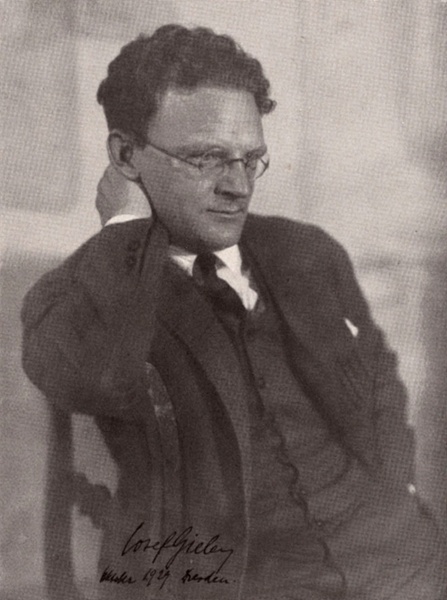


Josef Gielen was born on December 20, 1890, in Cologne. After studying art history and German literature and theater, he launched his career as an actor in Bernburg and Düsseldorf in 1913. With four years of army service behind him and having been engaged in Königsberg since 1919, Gielen stepped into the role of stage director at the Hessisches Landestheater in 1921. His second-ever production—the premiere of Georg Büchner’s Leonce und Lena—caused a scandal and sparked a fierce debate in the State Parliament.
In 1924, Gielen took an engagement at the Dresden State Theater. This was later described as “the best time of his professional life.” The young and politically aware celebrated him as “the strong counterpart” to the theater’s “traditionalists”. And he did not disappoint: he staged critical works like Arnolt Bronnen’s Anarchie in Sillian and Fritz von Unruh’s Louis Ferdinand, Prinz von Preußen in 1924 and 1925, followed by the premieres of Franz Jung’s Legende and Gerhard Menzel’s Toboggan in 1927 and 1928. Even more important than the relevance of the material was Gielen’s unmistakable style, which set him apart as a stage director. Critics spoke of the “breathtaking speed” with which a piece “eerily whisked by”, describing what they had just witnessed as a “compact density [...] that didn’t let an ounce of theatrical power go unused.” It came as no surprise that Fritz Busch borrowed Gielen for the premieres of Kurt Weill’s Der Protagonist in 1926, Heinrich Kaminski’s Jürg Jenatsch in 1929, and Mark Lothar’s Lord Spleen in 1930.
The star director’s talent caught the attention of no other than Richard Strauss, who entrusted Clemens Krauss and Josef Gielen with the premiere of his opera Arabella in Dresden on July 1, 1933, instead of Fritz Busch and Alfred Reucker, as originally planned. While Gielen seemed to have escaped the fate of so many of his colleagues in March of 1933, it caught up with him in 1935. Gielen had been married to the Jewish actress Rose Steuermann since 1922, an association that had implications in the new “racial laws”. Facing repression in Dresden, he terminated his contract in 1936 and took Clemens Krauss up on his offer to come to the Berlin State Opera. But any hope he had for Göring’s protection soon abated, and Berlin offered only brief respite. No sooner had he signed his three-year contract with special permission from the Reich Chamber of Culture than it all fell apart. Göring ordered the termination of his contract in June of 1937, and Gielen emigrated first to Austria and then, in 1939, to Argentina, where he worked as chief stage director at Teatro Colón in Buenos Aires. Expelled from the country by dictator Juan Perón in 1948, he returned to Vienna and worked at the Burgtheater. Josef Gielen died on October 19, 1968, in Vienna.
1890 Cologne
1968 Vienna