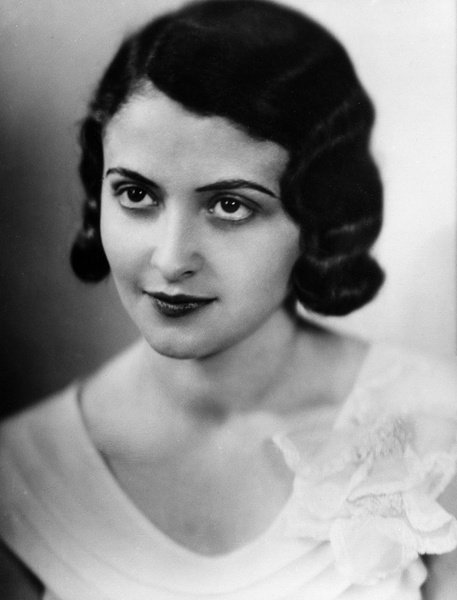


The soprano was born in Kostel, a small village in the south of the Czech Republic, at that time part of the Austro-Hungarian Empire, on December 8, 1903, to the merchant Jakob Eisinger and his wife Emilie. After studying singing at the Academy of Music and Performing Arts in Vienna, Irene Eisinger made her debut in 1926 at the Basel Stadttheater. In 1928, she moved to the Kroll Opera, where she quickly became one of the stars of the ensemble, and soon also performed at the Staatsoper Unter den Linden. She also performed as a guest at the Vienna State Opera and the Salzburg Festival, among other stages, in addition to appearing in film productions and singing on a number of gramophone recordings.
After the closure of the Kroll Opera, Eisinger was engaged at the Städtische Oper, where, as a Jew, she was dismissed shortly after the Nazis’ rise to power in 1933. Unable to perform in Germany, she fled to Czechoslovakia and took an engagement at the German Theater in Prague. She also performed as a guest in Brussels and Amsterdam, as well as at the Adelphi Theatre in London. Additionally, she regularly appeared at the Glyndebourne Festival.
As the political situation became increasingly dire in 1938, the singer decided to remain permanently in British exile. When the Glyndebourne Festival was closed at the outbreak of the war, she withdrew from the stage and performed only occasionally. Irene Eisinger died on April 8, 1994, in Weston-super-Mare, England.
1903 Kostel
1994 Weston-super-Mare