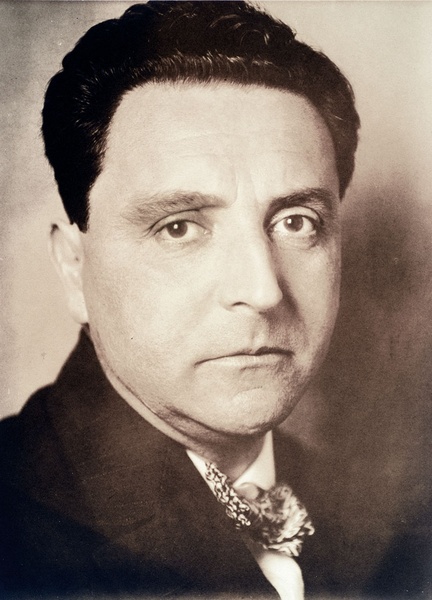
The actor Hugo Kohn, who performed under the stage name Hugo Kessler, was born on August 18, 1880, in Rosenheim, Upper Bavaria. After making his debut in 1898 at the Bromberg Stadttheater, he initially performed at numerous small theaters before joining the Hamburg Schauspielhaus in 1912. Kessler served as a soldier in the First World War from 1915 onward and upon his return in 1918 worked at the Harburg Stadttheater. In 1921, he moved to Berlin and performed at the Theater am Kurfürstendamm in 1923/24.
In September of 1924, Kessler was engaged by the Hessian Landestheater Darmstadt, where he soon became one of the ensemble’s most important actors. He won the favor of critics and audiences primarily through numerous appearances in prominent supporting roles, including in Gogol’s The Government Inspector, Bruckner’s Die Verbrecher, Schiller’s William Tell, Goethe’s Egmont, and productions of Shakespeare’s plays. He also occasionally appeared in leading roles, such as Peachum in The Threepenny Opera in 1929.
Because Kessler was Jewish, the Nazis’ seizure of power brought his career to an abrupt end. On March 31, 1933, he was placed on leave only to be assigned several roles again in April. On July 25, 1933, he finally received his official dismissal. Kessler initially remained in Darmstadt, where he lived in an apartment on Herrngartenstraße. On November 11/12, 1938, shortly after the November Pogroms, he was deported to the Buchenwald concentration camp as part of the nationwide wave of arrests targeting so-called “Action Jews”, but was released after four weeks.
To escape further persecution, he fled to the Netherlands at the beginning of 1939, leaving behind all of his possessions in Darmstadt. This marked the beginning of an odyssey through various Dutch refugee camps for Kessler, until he eventually found accommodation in Amsterdam. From there, he attempted to obtain permission to emigrate to Peru to join his brother, but these efforts were thwarted by the German occupation of the Netherlands in May of 1940. On May 10, 1940, the occupiers deported him to the former refugee camp Westerbork, which had by then been converted into a central internment camp for Dutch Jews and Jewish refugees. After two years of imprisonment, he was released in July of 1942 and subsequently lived in one of Amsterdam’s districts where the German occupiers had forced the majority of Dutch Jews into a ghetto.
On April 8, 1943, Kessler was imprisoned once again at Westerbork, which had by then become the central transit camp for the deportation of Jews living in the Netherlands, officially designated as a “Police Jewish Transit Camp”. Beginning in July of 1942, freight trains left the camp once or twice a week, transporting the majority of its inmates to Auschwitz and the extermination camp Sobibor. On May 4, 1943, Kessler was deported to Sobibor on one of these trains, together with 1,186 other people. After a three-day journey in a severely overcrowded freight car, the prisoners were taken directly to the gas chambers upon arrival. Because few records survived for these mass killings, Hugo Kessler’s death was retrospectively dated May 7, 1943.
1880 Rosenheim
1943 Sobibor (Extermination Camp)