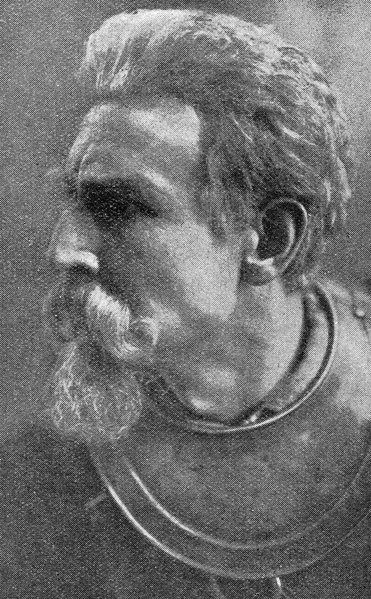


Hermann Wucherpfennig, who had completed a doctorate in philology, received his vocal training under Rudolf von Milde in Dessau and Vittorino Moratti in Berlin. The bass received his first engagement in 1905 at the Dessau Hoftheater and moved to the Nuremberg Stadttheater in 1909. After positions in Düsseldorf and Charlottenburg, he was engaged at the Karlsruhe Landestheater from 1922 to 1931. There, in 1926, Wucherpfennig also took part in the world premiere of Siegfried Wagner’s Der Friedensengel. His signature roles included Daland in The Flying Dutchman, Pogner in Die Meistersinger von Nürnberg, and the Landgrave in Tannhäuser. In addition to his permanent engagements, he also undertook guest tours throughout Europe and South America. From 1908 to 1911, he was a member of the Bayreuth Festival choir, and in 1911 he also sang the solo role of the Night Watchman in Die Meistersinger von Nürnberg. After retiring from the stage, Wucherpfennig became a lecturer at the Academy of the Baden Landestheater in Karlsruhe in addition to running a private voice school together with his wife, Irma Raven, whom he had married in 1912. Raven was a soprano who also performed under the name Irma Rappaport.
Through the mediation of Klaus Pringsheim, Wucherpfennig received an appointment in 1932 at the Imperial Music Academy in Tokyo. His wife, who was Jewish, accompanied him.
Under the laws of the Third Reich, her Jewish background had implications for Wucherpfennig as well. As a result, he lost his position at the academy in Tokyo on April 1, 1943. In a document issued by the German embassy, he was described as a “musician in whose professional activity the German embassy has no interest.” His wife also lost her professorship in music.
After the war, Wucherpfennig was reinstated at the academy and continued his work in Tokyo until 1953, when he and his wife returned to Karlsruhe. Hermann Wucherpfennig died there on August 29, 1969.
1884 Mühlhausen (Thuringia)
1969 Karlsruhe