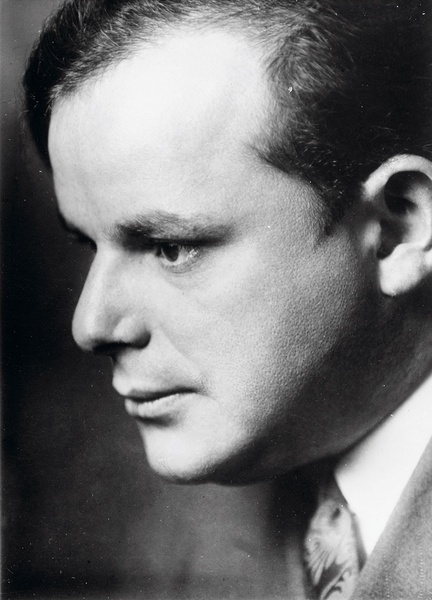
Born on December 5, 1899, in Basel, the actor Hermann Gallinger made his stage debut at the city’s Stadttheater in 1920. After engagements in Frankfurt, Altona, Bremen, and Zurich, he joined the Darmstadt Landestheater in 1927. Critics praised his leading performance in Nikolai Gogol’s The Government Inspector, describing him as “not yet fully accomplished in every respect, but already remarkably strong in his characterization.” Gallinger soon became one of the theater’s busiest actors, appearing in contemporary plays, comedies, and operettas. It was not until the arrival of General Director Gustav Hartung that Gallinger was cast in major classical roles, including Romeo and Juliet, Wallenstein’s Death, and Michael Kramer. In May of 1932, Hartung directed him to a major triumph in André Gide’s Oedipe. Just one year later, however, the audience favorite was driven from the theater.
Gallinger and his friend Karl Paryla were the first members of the company to be placed on leave, just three days after the dismissal of General Director Gustav Hartung. According to the theater management, their services were “no longer required for the remainder of the season,” and they were told they could leave immediately. When payment of their salaries was suspended, the two actors challenged the decision. After three months, their attorney succeeded in securing the release of the withheld wages. Gallinger and Paryla had been summarily dismissed because they were regarded as “Communists”. The new Nazi authorities apparently feared that, protected by their Swiss and Austrian citizenship, respectively, and by their popularity with audiences, the two friends might organize resistance to the planned mass dismissals. At the same time, the newly appointed NSDAP theater official, Werner Kulz, sought to demonstrate to his fellow party members that he would carry out the planned purge without regard for personal relationships—despite the fact that Gallinger was his brother-in-law. The extent to which these fears were justified, from the Nazi perspective, was underscored by the fact that Der Datterich, a weekly newspaper known for its sharp satirical commentary on local events, called for the reinstatement of both actors on March 24, 1933.
Hermann Gallinger returned to Basel in April and rejoined the Stadttheater. Gustav Hartung, who had also fled to Basel, staged his very first production there in May of 1933 featuring Gallinger in a leading role. The theater’s resident directors likewise valued the prominent returning actor. In the popular revue Grüezi, a major stage success, Gallinger was able to showcase his musical talents in 1935. Meanwhile, his political engagement remained undiminished: in 1937, he became a target of the right-wing National Front for participating in a solidarity event in support of the threatened Spanish Republic and for taking a leading role in Karel Čapek’s anti-fascist play The White Plague. When Hartung became senior stage director at the Basel Stadttheater later that same year, Gallinger was already one of Switzerland’s most popular actors. His appearances in numerous films further strengthened his reputation. He now portrayed major roles from world literature—such as Nathan, Julius Caesar, Caliban, and Shylock—while also helping to establish Bertolt Brecht’s works on stage, including roles such as the chaplain in Mother Courage and Her Children and the barber in The Good Person of Szechwan. Gallinger remained a member of the Basel Stadttheater until 1952. He died on June 3, 1962, in Ronco sopra Ascona, Ticino.
1899 Basel
1962 Ronco sopra Ascona