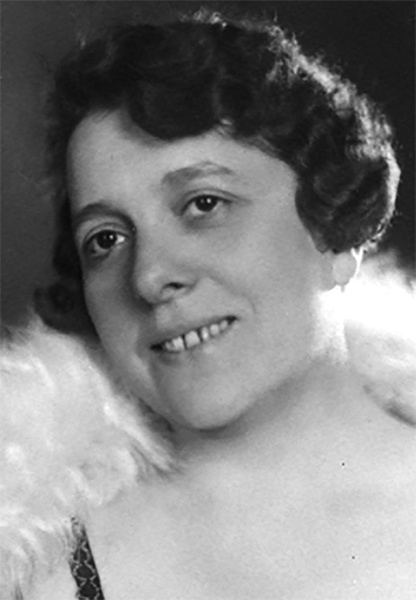


Henriette Gottlieb made her debut in 1909 at the Stadttheater in Plauen. The Berlin native was then engaged at the Städtische Oper in Berlin-Charlottenburg on September 1, 1912, where she remained until her dismissal in 1933. Audiences in Berlin saw her in the roles of Rezia in Carl Maria von Weber’s Oberon in 1912, the queen in Heinrich Marschner’s Hans Heiling in 1915, and Rachel in Halévy’s La Juive in 1918, among others. Gottlieb, who sometimes performed by the name Gottlieb-Huth after her marriage to the merchant Carl Huth, was celebrated for her Wagner performances. She appeared at the Bayreuth Festival from 1927 until 1930. After a guest engagement in Paris in 1930 in a production of Die Walküre, she sang the part of Brünnhilde on gramophone recordings.
Her career came to an abrupt end when the Nazis’ came to power in 1933: after 21 years as an ensemble member of the Städtische Oper in Berlin-Charlottenburg, her employment was terminated on May 30, 1933, on the basis of the recently passed “Law for the Restoration of the Professional Civil Service”—Henriette Gottlieb was, after all, a Jew. Her attempts to appeal her dismissal by legal means proved fruitless and resulted in a grueling legal battle over her pension. Employment at other opera houses in Germany as well as with the Jewish Cultural Federation in Berlin proved out of reach. With Carl Huth also out of work as a Jew, the couple struggled to make ends meet. After making multiple pleas for support to her former workplace, she was finally granted a reduced pension in March of 1935, nearly two years after her dismissal.
The conditions under which the Gottliebs lived over the following years remain unknown. Their names remain absent from the records until the deportation of Jews from Berlin commenced in 1941. They were part of the second group of some 1000 Jews to be transported to the Łódź Ghetto on October 24, 1941. Henriette Gottlieb succumbed to the harsh conditions there on January 2, 1942. Her husband Carl Huth died just months later, on May 3, 1942.
1884 Berlin
1942 Lodz/Litzmannstadt (Ghetto)