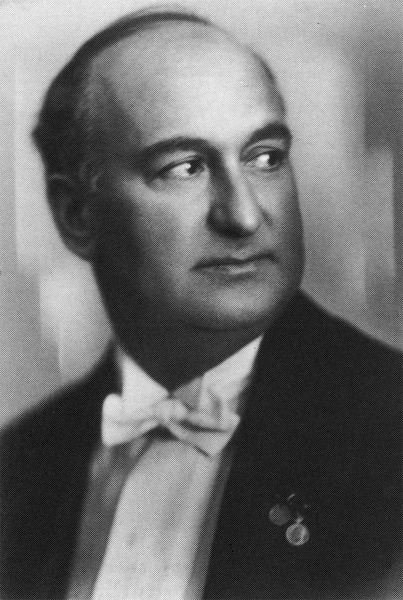


Hendrik Prins was born in The Hague, where he started learning violin. In 1898, he began his formal music studies in Dresden as a student of Henri Petri and continued his training in 1901 under August Wilhelmj in London. He began his professional career as concertmaster at the opera in Chemnitz and later played in orchestras in St. Petersburg, London, Altenburg, and Strasbourg. On November 1, 1921, he took on a temporary position of concertmaster of the orchestra of the Städtische Bühnen in Hanover and just weeks later was granted a permanent position due to his “outstanding performance.” He became a German citizen on April 11, 1922.
After having already played violin in the orchestra at the Bayreuth Festival in 1909, Prins applied to participate in the first festival season after the end of World War I. His application was denied for a single reason: Hendrik Prins was Jewish. During the discussions on the orchestra’s personnel, Karl Muck, the conductor responsible for assembling the ensemble, rejected his “feeble petition” and added: “Frankly, the idiot is not even worth a reply.”
When the Nazi Party came to power in Germany in 1933, Hendrik Prins became a target of state-sanctioned anti-Semitism. By decree of the Prussian Ministry of the Interior on December 19, 1933, he was forced into retirement at the age of just 52 under the provisions of the “Law for the Restoration of the Professional Civil Service”. However, because of his long-standing civil service status, this measure had to be revoked. Prins was therefore initially allowed to remain in his position until the “racial laws” enacted in September of 1935 provided the legal basis for the removal of remaining Jewish officials. On October 8, 1935, Prins was “placed on leave with immediate effect” and forcibly retired at the end of the year with a reduced pension. Unemployed, with no career prospects in Germany, and shunned by former colleagues, he remained in Hanover, continued teaching in his apartment, and played chamber music in private circles. He may even have rejected an opportunity to flee abroad—Prins did not see himself as Jewish and apparently underestimated the steadily increasing danger. In February of 1943, he was denounced and arrested. He was first imprisoned in Brandenburg an der Havel and then deported to Auschwitz, where he died on June 29, 1943.
1881 The Hague
1943 Auschwitz (Concentration and Extermination Camp)