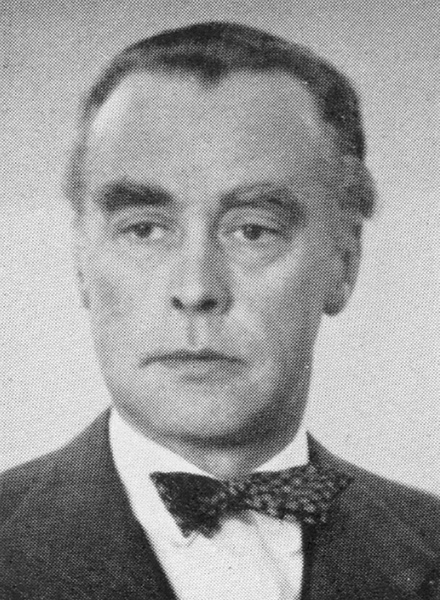


Born on April, 1893, in Stockholm, the Swedish native studied business before launching his theater career in 1914 as an assistant director under Max Reinhardt and later at the Hofoper in Munich. Directorial engagements followed at theaters in Bern, Frankfurt, and Riga, and in 1919 he was brought on as a director at the Royal Opera in Stockholm. Stuttgart general director Albert Kehm knew him from their time together at the Stadttheater in Bern and recommended him as the successor to the senior stage director at the time. The committee’s only objection to Stangenberg was that he was a foreigner. On August 1, 1927, he took up an engagement at the Württembergisches Landestheater.
As the new senior stage director, Stangenberg staged at least half of each season’s ten productions. These included contemporary pieces (Zeitopern) like Paul Hindemith’s Cardillac, Ernst Krenek’s Jonny spielt auf and Leben des Orest, and Kurt Weill’s and Georg Kaiser’s Der Protagonist and Der Zar lässt sich photographieren, but also other interesting, lesser known works like Arrigo Boito’s Nerone, Jacques Halévy’s La Juive, Igor Stravinsky’s L’Histoire du soldat, and Antonín Dvořák’s Rusalka. However, Stangenberg was only able to maintain such an exciting repertoire for three years before the more traditional canon took precedence once again. According to the theater’s internal language policy, operas that had already been slated for production like Alban Berg’s Wozzeck, Mahagonny by Brecht and Weill, and Jaromír Weinberger’s The Outcasts of Poker Flat had to be abandoned until “the political situation calm[ed] down.”
The Nazi Party used the premier of Ossip Dymow’s comedy Shadows over Harlem in Stuttgart in October of 1930 as an opportunity to spew their hatred for Black people and Jews. Shortly thereafter, the National Socialists characterized Harry Stangenberg as the epitome of the “freeloading and alien” foreigner. “At the Stuttgart Landestheater,” the Völkische Beobachter reported on November 20, 1930, “there is a foreigner (a Swede), Harry Stangenberg, who is also said to be Jewish. This man ... has been practicing his own version of ‘German art’ for two years ... The German taxpayer is paying the foreigner who is standing in the way of the German people and staging outlandishly foreign and Jewish operas with German money. How long will this go on?” The NS-Kurier in Stuttgart also attacked Stangenberg because of his supposedly arbitrarily “modern” directorial style and suggested that he possessed not the slightest comprehension of Richard Wagner’s “immortal works”.
The answer to the Völkische Beobachter’s menacing question of how long this would go on was answered in late March of 1933. The new general director and Nazi Party member Otto Krauß informed Stangenberg that he was standing in the way of the “complete reorganization of the directorate.” In order to avoid any diplomatic incidents, the Swede was insidiously advised to apply to theaters in Berlin. But by then, people like Stangenberg had no place in Germany, and so on July 12, 1933, he went back to Sweden, where he worked as a freelance director and in 1938 returned to the Royal Opera in Stockholm as senior stage director. Harry Stangenberg died on November 3, 1941, in Stockholm.
1893 Stockholm
1941 Stockholm