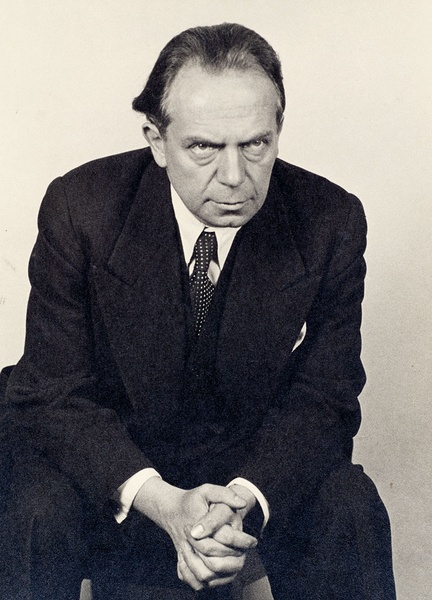
Born under the surname May on January 30, 1887, in Bartenstein, Gustav Hartung began his career as an actor under Max Reinhardt in Berlin. During his engagement at the Frankfurt Schauspielhaus from 1914 to 1920, he became its most important director and one of the formative figures of Expressionist theater. In Darmstadt, Hartung brought this new artistic movement to its peak, staging works by Kasimir Edschmid, Fritz von Unruh, and Carl Sternheim. In Berlin’s theatrical circles, this development was referred to as “Darmstadt Expressionism”. Hartung’s distinctive artistic signature lay in the complete unification of all elements within structurally fragmented plays, in the inventive visualization of often abstract–idealist ideas, and in transforming individual acting talents into an overwhelming collective energy. This style also shaped Hartung’s productions of classical drama and opera. However, while prominent figures from the wider art world attended his premieres, local conservative nationalist and Christian newspapers, along with regional parliamentary parties, began organizing a sustained campaign against the theatrical innovator. Exhausted by the mounting pressure, Hartung left for Cologne in 1924. From that point on, his fortunes declined. In 1925, he was dismissed after staging a supposedly “indecent” play from the Shakespearean era, and the Heidelberg Castle Festival, which had begun with great success in 1926, ultimately failed, as did his takeover of the Berlin Renaissance Theater in 1927. In 1931, despite fierce opposition from a broad coalition ranging from the Center Party to the NSDAP, he was once again appointed in Darmstadt. However, his tenure as artistic director, rich in theatrical highlights, ended abruptly on March 13, 1933, when the newly elected state president Ferdinand Werner informed him that, due to his “political past”, he was “not acceptable” for the new state.
On March 15, 1933, Gustav Hartung crossed the border into Switzerland, where he staged a production in Basel that May. This was followed by work at the Schauspielhaus Zürich, including the premiere of Ferdinand Bruckner’s Die Rassen, a passionate indictment of the emerging persecution of Jews in Germany, that November. Shortly after his arrival, Hartung publicly attacked the new regime in radio broadcasts. In July of 1934, on the occasion of the reopening of the Heidelberg Festival under Joseph Goebbels and in memory of the murder of actor Hans Otto by the SA, he penned an open letter to artists who had remained in Germany, warning them of the consequences of continuing to work under the Nazi regime: “Whoever bows before murderers and accomplices to murder glorifies murder and turns it into a model.” Such outspoken statements made Hartung a target of Nazi hostility. Through sympathetic contacts in Switzerland and pressure exerted via the German embassy, his election as general director in Bern in 1934 was annulled, and his contract as senior stage director in Basel, concluded in 1937, was allowed to expire after two seasons due to a boycott imposed by Joseph Goebbels. By then suffering from heart disease, the director was forced to support himself as a drama teacher at the Basel Conservatory. Gustav Hartung left Switzerland in October of 1945 to take over the management of the Kammerspiele in Heidelberg. He died there on February 14, 1946.
1887 Bartoszyce (Bartenstein)
1946 Heidelberg