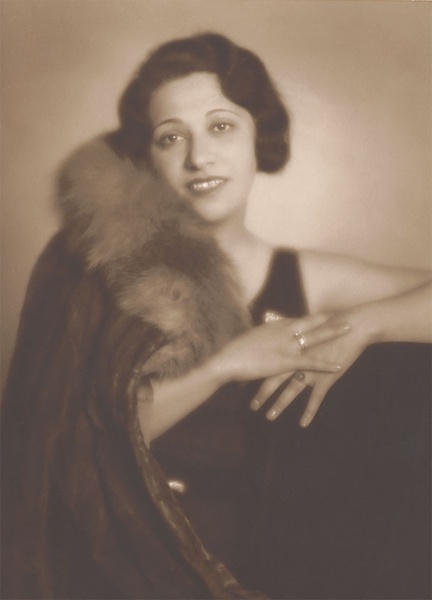
Born on March 23, 1895, in Vienna, Fritzi Jokl studied with the music teacher Hedwig Kanner-Rosenthal, the wife of the piano virtuoso Moritz Rosenthal. She began her career in 1917 as a soprano at the Frankfurt Opera before moving to the Hessian Landestheater Darmstadt for one season in 1923. She joined the Berlin Volksoper later that year and, after its closure in 1925, moved to the Cologne Opera. In 1926, she received an engagement as first soprano at the Bavarian State Opera in Munich, where she remained until 1932. Her guest appearances also took her to the Salzburg Festival, where she sang Despina in Così fan tutte in 1928, as well as to the Royal Opera House in London’s Covent Garden, the Vienna State Opera, and Amsterdam.
The singer’s repertoire included a number of coloratura roles, among them Urbain in Giacomo Meyerbeer’s Les Huguenots, Oscar in Verdi’s Un ballo in maschera, Konstanze and Blonde in Mozart’s The Abduction from the Seraglio, Norina in Gaetano Donizetti’s Don Pasquale, and Violetta in Verdi’s La traviata.
When a planned move to the Kroll Opera in Berlin fell through because of its closure, Fritzi Jokl returned to the Landestheater Darmstadt in 1932 and subsequently saw her career fall apart after the Nazis came to power. Dismissed in the spring of 1933 because of her Jewish background, she initially became active in the Jewish Cultural Federation, becoming one of its undisputed stars. In performances by the Berlin section of the Cultural Federation, she sang roles such as Micaëla in Bizet’s Carmen, Susanna in Mozart’s The Marriage of Figaro, and Olympia in Jacques Offenbach’s The Tales of Hoffmann.
In May of 1936, Fritzi Jokl left Germany and fled via Austria to Montreal, Canada. From there, she emigrated to the United States on June 23, 1937, crossing the border at Rouses Point, and subsequently settled in New York. There, she married her second husband, the journalist Jack Siegel, in 1942.
Unable to continue her artistic success in exile, the singer ended her career, performing only occasionally at concerts put on by émigré organizations and events within the Jewish community. Jokl died on October 15, 1974, in New York.
1895 Vienna
1974 New York