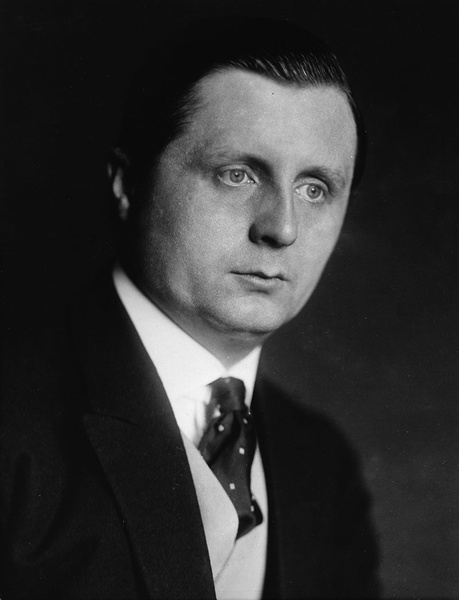


Born on March 13, 1890, in Siegen, the Westphalian Fritz Busch outwardly fit the Nazi ideal of the “Aryan type”, yet, as his colleague Antal Dorati remarked, he was “the least German of German conductors.” From 1906 to 1909, he studied conducting under Fritz Steinbach in Cologne. From 1910 to 1912, he served as music director in the spa town of Bad Pyrmont and, beginning in 1912, as music director in Aachen. At the outbreak of World War I in 1914, he volunteered for military service and returned severely wounded. After the war, in 1918, he became chief music director at the Stuttgart Opera. There, in 1921, he conducted the premieres of Paul Hindemith’s Mörder, Hoffnung der Frauen and Das Nusch-Nuschi. In 1922, he was appointed chief music director in Dresden. There as well, he made a name for himself with spectacular premieres, including Richard Strauss’s Intermezzo in 1924, Ferruccio Busoni’s Doktor Faust in 1925, Hindemith’s Cardillac in 1926, and Strauss’s Die ägyptische Helena in 1928. In 1924, he conducted the first performance in Bayreuth after the war with Wagner’s Die Meistersinger von Nürnberg. In 1932, he staged Giuseppe Verdi’s Un ballo in maschera in Berlin with Carl Ebert—an event that became a milestone in the German Verdi revival he helped initiate.
As a committed democrat, Fritz Busch was no friend of the Nazis—least of all the Saxon Nazis, who accused him of “associating with Jews,” employing “Jewish and foreign singers,” and earning too high a salary On March 7, 1933, 50 SA men led by the Nazi Party’s theater division occupied the stage of the Semperoper. Their leader, the actor Alexis Posse, had Busch removed from a rehearsal and dismissed him from office. That same evening, hundreds of Nazis distributed throughout the audience prevented the dismissed opera director from conducting Rigoletto by chanting slogans. Hermann Göring’s attempts to place Busch in a prominent position at one of Berlin’s opera houses failed due to Hitler’s refusal to publicly rehabilitate him—and likely also due to Busch’s own resistance. To buy time, Busch, together with Carl Ebert, was sent to the Teatro Colón in Buenos Aires for a guest engagement in June of 1933. After returning to Europe, he became director of the Glyndebourne Opera Company in Britain, where he and Ebert staged widely acclaimed productions of Mozart’s three Da Ponte operas—performances that also became landmark recordings. In 1941, he succeeded Erich Kleiber as director of the Teatro Colón. From 1945 onward, he worked primarily at the Metropolitan Opera in New York. Fritz Busch died on September 14, 1951, in London.
In March of 1990, the Dresden State Opera posthumously named him an honorary member as one of the greatest conductors of Mozart, Verdi, Wagner, and Strauss. He was a man of integrity and unwavering principle who lived by the motto: “It is more important to behave decently than to make good music.”
1890 Bad Pyrmont
1951 London