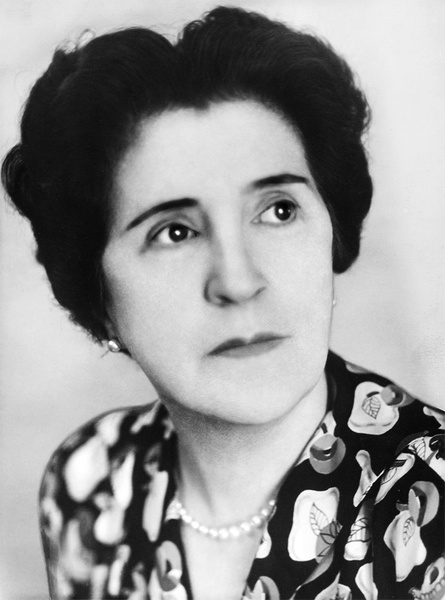


Born on April 18, 1888, in Berlin, Frida Leider trained as a bank clerk while taking private singing lessons on the side. She made her debut in 1915 at the Stadttheater in Halle, playing Venus in a production of Tannhäuser. This was followed by engagements in Rostock and Königsberg. In 1919, she began performing at the Stadttheater in Hamburg, breaking through with her performances in Wagnerian roles. In 1924, she moved to the Berlin State Opera. Leider was involved in the premieres of Ernst Krenek’s opera Die Zwingburg and was celebrated for her performances of Brünnhilde in Der Ring des Nibelungen, Kundry in Parsifal, and Isolde in Tristan und Isolde. She also proved to be a capable performer of Verdi in roles like Leonore, Amelia, and Aida.
By the time she began performing at the Bayreuth Festival in 1928, she had already become an international star from guest performances at the Waldoper Zoppot in 1924 and 1925 as well as from her annual engagements at the Covent Garden Opera in London from 1924 until 1938. After 1928, she performed as a guest at the Chicago Opera, the Grand Opéra in Paris, Teatro Colón in Buenos Aires, and, from 1933 until 1934, the Metropolitan Opera in New York.
Frida Leider’s life changed in 1933: even before the Nazi’s came to power, rumors had been circulating about the singer’s supposed Jewish ancestry. In response to an inquiry made by a fellow party member, Hans Hinkel, an official at the Ministry of Propaganda who oversaw the “Jewish question”, reported in 1935 that Leider was a Jew. However, aware of her international reputation, he called for restraint in public acts of disruption, noting that “one can go on the offensive later in the press.” When it eventually came out that Frida Leider was not Jewish after all, and Winifred Wagner intervened “in the interest of the Bayreuth Festival”, she suddenly found herself being attacked because of her husband. Hinkel confirmed that she was “married to the Jewish violinist Demann [sic!].” Rudolf Deman, former concertmaster of the Berlin State Opera, was indeed Jewish, meaning Frida Leider had Jewish family ties. Heinz Tietjen, general director of the Prussian State Theater, offered reassurance, but because the singer refused to divorce her husband, he began looking for a replacement in 1934. After one had been found, Hans Hinkel announced on June 4, 1937, “the premature departure of Mrs. Leider in the foreseeable future.”
With her husband having been stripped of his citizenship through the annexation of Austria in March of 1938 and fleeing to Switzerland, it was the beginning of the end of her career. Her contract, which was originally due to expire in 1940, was redrafted as a guest performance agreement, and she was now outcast in Bayreuth too. After 1940, she performed in her own programs as a singer of art songs. As of 1942, she was no longer an ensemble member at the Berlin State Opera. After the war, she ran the vocal studio of the East Berlin State Opera and worked as a stage director. She also taught at the West Berlin Academy of Music until 1958. Frida Leider died on June 4, 1975, in Berlin.
1888 Berlin
1975 Berlin