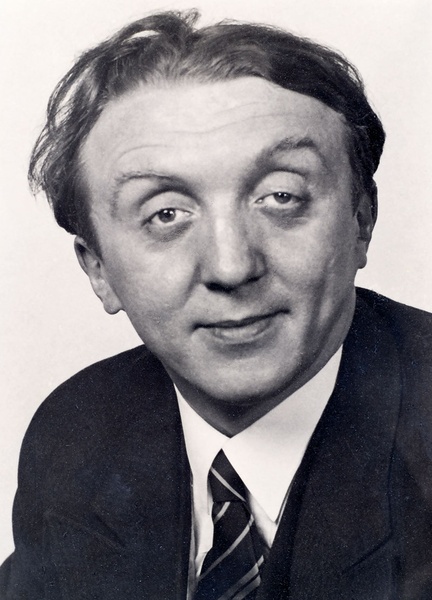
Eugen Gürster was born on June 23, 1895, in Fürth. After completing his secondary education, he began serving as a soldier in the First World War in 1915. He subsequently studied musicology, archeology, and philology in Munich, completing his studies in 1923 with a doctorate thesis on the Austrian playwright Ferdinand Raimund. In 1924, he took up a position as dramaturge in Breslau (present-day Wrocław, Poland) and also worked as a journalist and writer. In 1932, Gürster joined the Hessian Landestheater Darmstadt as dramaturge, but he was dismissed for political reasons in June of 1933.
Gürster fled to Switzerland, where he published numerous articles under a pseudonym in newspapers, magazines, and radio broadcasts. His writings Die Zukunft der Freiheit (The Future of Freedom), Die Judenfrage eine Christenfrage (The Jewish Question: A Christian Question), and Die Rolle des Bösen in der Weltgeschichte (The Role of Evil in World History) were placed on the list of “undesirable literature” in Germany. After being stripped of his German citizenship and having his doctoral degree revoked in 1941, Gürster left Europe and emigrated to the United States. There, he worked as an author for the émigré newspaper Aufbau and taught at various colleges.
In 1952, he returned to Germany and joined the Federal Foreign Office. From 1953 to 1959, he served as cultural attaché in London, subsequently holding the same position in Vienna until 1962. Eugen Gürster died on May 1, 1980, in Munich.
1895 Fürth
1980 Munich