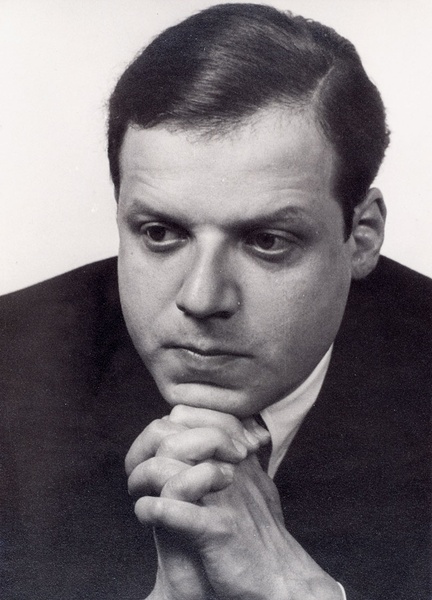
Ernst Ginsberg was born on February 7, 1904, in Berlin. After completing his secondary education, he joined a free theater company in Heide, Holstein, in 1922 and learned his craft while touring Germany with the troupe. After engagements at the Hamburg and Munich Kammerspiele and at the Düsseldorf Stadttheater, he joined the Volksbühne in Berlin in 1928 while also guest performing on nearly all of the city’s stages. He quickly attracted attention; the Darmstadt theater director Gustav Hartung described him as “by unanimous judgment one of the most intelligent actors of the younger generation” and sought to engage him. In 1932, Ginsberg accepted Hartung’s invitation to move to Darmstadt, describing it as an opportunity “to prove [himself] in major classical roles.” There he performed in roles such as Gessler in William Tell, Burleigh in Mary Stuart, and Don Alvaro in The Mayor of Zalamea. The critically acclaimed start of his engagement, however, ended just six months later: because he was Jewish, he was placed on leave on March 31, 1933. Neither his letter to the new theater administration—describing himself as a “German actor” who had never wished to feel like a “guest” in Germany—nor his meeting with the newly appointed NSDAP theater official Werner Kulz could prevent his dismissal on June 3, 1933. Kulz initially thanked Ginsberg for the “many great impressions” he had received from him at the theater, but then added regretfully that private “small interests ... must now give way to the greater interests of racial purification.”
After Ginsberg decided not to perform in the “ghetto” of the Jewish Cultural Federation in Berlin, exile became his only option. When his first attempt to establish himself in Vienna failed, he was rescued by an offer from the former Darmstadt director Gustav Hartung, who had also been forced into exile. Hartung invited him to play the role of the young Jew Siegelmann in the premiere of Ferdinand Bruckner’s play Die Rassen at the Schauspielhaus Zürich. The production became a landmark event: it depicted how, under the racial ideology of Nazi Germany, lovers were torn apart and innocent people were publicly humiliated and beaten because of their alleged “alien” blood. Ginsberg later recalled the premiere on November 30, 1933, at which Thomas Mann, Bruno Walter, Ernst Deutsch, and other prominent exiles were sitting in the audience: “The inner tension in which I found myself was almost unbearable. And then a voice came from the gallery; it was, as I later learned, a young Swiss man who found it incomprehensible that someone would allow this to happen to themselves. He shouted, he pleaded with me: ‘Siegelmann, Siegelmann, help yourself!’ It was the intrusion of reality into the theater.”
Ginsberg, whose contract was initially extended only in two-week intervals, remained in Zurich until 1946. During this time, he performed many of the great roles of the classical repertoire, including Franz Moor, Carlos, Hamlet, Mephisto, Orestes, and Tasso. In 1946, he became senior stage director at the theater in Basel and, from 1952 onward, he moved between Zurich and Munich as a director and an actor. During these years, he discovered the works of Molière, an encounter he later described as his “artistic destiny and good fortune.” In roles such as Harpagon, Tartuffe, and Alceste, Ernst Ginsberg ultimately established himself as one of the most significant German actors of the 20th century. He died on December 3, 1964, in Zurich.
1904 Berlin
1964 Zurich