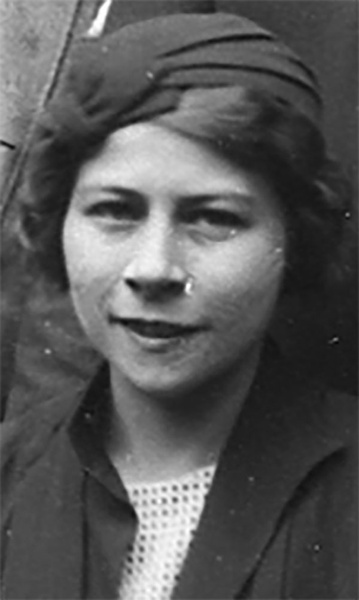


Enid Szánthó grew up in Budapest as the daughter of a Hungarian government official and his Irish wife. She studied at the Royal Academy of Music there and, at just 21 years old, began her career in 1928 at the Vienna State Opera. She quickly rose to a prominent position, as evidenced by a 1932 letter from the general management to the federal theater administration responsible for personnel matters: “Miss Szánthó possesses a magnificent contralto, one seldom heard … and already ranks at the very top of her Fach. The management places the greatest value on retaining this artist, as she could scarcely be replaced by anyone of equal caliber.” Her exceptional alto voice also made her a sought-after performer in Bayreuth, where she appeared from 1930 to 1937. In the 1930s, she embarked on an international guest career that took her to Florence, New York, and Minneapolis in 1935; to Berlin and London’s Covent Garden Opera in 1936; and to the Metropolitan Opera in New York in 1937.
The Nazis’ rise to power in Germany in 1933 initially did not affect Szánthó. This changed, however, with Germany’s annexation of Austria in March of 1938, after which she was classified as “half-Jewish”. She survived the first wave of “purges” at the Vienna State Opera in April of 1938 only because no adequate replacement could be found. A few months later, in August of 1938, her contract expired. When Szánthó attempted to secure a new contract, the management began to stall. In September, “the question of her permission to perform had not yet been decided by those in charge,” and in November her application still required the “special authorization prescribed for non-Aryan persons.” Only in March of 1939—by which time Szánthó was back in New York seeking new engagements—did the State Opera finally inform her that “the conclusion of a contract was not to be expected.” Bayreuth, too, no longer wished to engage her: the festival’s artistic director, Heinz Tietjen, justified her exclusion in 1938 by stating that he wanted “to engage a German artist rather than a foreign one for her roles.”
The singer opted to return to Budapest for a short time in 1939 before leaving Europe altogether and emigrating to the United States in October. In the following years, she appears to have performed mainly in concert settings, including in Pittsburgh, Pennsylvania, and at Oklahoma State University. She also appeared in 1945 with the New York City Opera on Broadway. After the war, she gave guest performances in Paris in 1946. No details are known about the course of Enid Szánthó’s later life. She was buried in 1997 at Kensal Green Cemetery in London.
1907 Budapest
1997 London