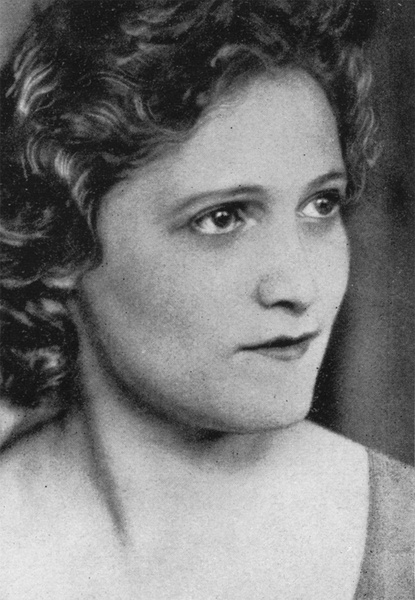


Emy von Stetten came from a well-known musical family in Königsberg. The singer’s father, Max Brode, had been a violin student of Joseph Joachim, conducted the Philharmonic Orchestra and the Singakademie in Königsberg, taught as a professor and academic music director at the local university, and played a major role in shaping the city’s musical life. His daughter also embarked on a promising career. After studying voice at the Berlin Academy of Music from 1912 to 1916, she married the Austrian painter Norbert Freiherr von Stetten in 1917 and began performing under the name Emy von Stetten in 1923 as a sought-after concert, oratorio, and lieder singer. In 1924, she appeared at the Göttingen Handel Festival; in 1925, she guest-starred as Olympia in The Tales of Hoffmann at the Dresden State Opera; and in 1929, she performed at the Handel Festival in Halle. On April 1, 1929, Emy von Stetten started working as an instructor for solo voice at the State Academy for Church and School Music in Berlin. Her colleagues praised her as a “good teacher” and an “outstanding artist” who enjoyed “the highest confidence among both faculty and students.” In 1933, she was invited to the Wagner Festival in Bayreuth.
Her career came to an end when the Nazis came to power in 1933. Because her father was Jewish, Emy von Stetten was classified as “half-Jewish”. When the purges began at the academy in April, she fought desperately to keep her position. Having worked as a nurse with the Red Cross during World War I, she attempted to obtain the protected status of a “front-line veteran”. She also pointed to her husband’s membership in the Nazi Party and argued that she herself had not joined only because, as a public employee, she had been prohibited from doing so—adding that as a “Nazi wife” she had already faced hostility during the Weimar Republic. These arguments proved no more effective than her petitions to the Prussian Ministry of Culture and Minister President Hermann Göring. She was dismissed on July 10, 1933, and on July 18—while she was in Bayreuth—the academy director informed her that her appeals had failed. Two years later, in August of 1935, she was expelled from the Reich Chamber of Music, thereby losing any possibility of practicing her profession. Only after a prolonged struggle did she succeed, in 1936, in obtaining a special permit that could be revoked at any time.
In the following years, Emy von Stetten lived under unknown circumstances in Berlin. In January of 1945, she was slated for compulsory labor service as a “Mischling”, though it is unclear whether this was ever carried out. After the war, she worked at the Hamburg Volksoper until 1948 and then, into the 1960s, as a lecturer at the Frankfurt Academy of Music. Emy von Stetten died on February 22, 1980.
1898 Konigsberg
1980 Frankfurt am Main