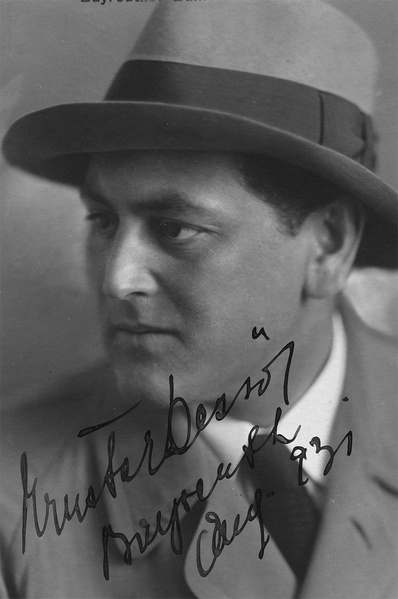


The son of a Hungarian synagogue cantor, Desző Ernster studied singing in Budapest and Vienna. In 1923, he made his debut at the Plauen Stadttheater as the Landgrave in Tannhäuser. The following year, he moved to the theater in Barmen-Elberfeld, and from 1925 to 1928 he was engaged at the Duisburg Stadttheater. From 1928 onward, the bass performed in smaller roles at the Berlin State Opera and at its experimental stage, the Kroll Opera. In 1931, Ernster was engaged by the Düsseldorf Opera, where he quickly became a key member of the ensemble and, in the years that followed, built up an extensive Wagner repertoire. That same year, he also appeared at the Bayreuth Festival, singing Titurel and the second knight in Parsifal, the steersman in Tristan und Isolde, and Reinmar in Tannhäuser.
After the Nazis came to power, when “purges” began at his home theater in Düsseldorf in April of 1933, it briefly seemed that he might be spared because of his Hungarian citizenship. However, when the city’s theater committee decided on May 18, 1933, not to approve his already prepared contract, his career came to an end. As a Jew, he no longer had any professional prospects in Germany and went into exile. In October of 1933, he undertook a guest engagement in Graz and remained there until 1936. It is unclear exactly when he left Europe, but he began performing at the Metropolitan Opera in New York in 1938.
For reasons unknown, Ernster returned to his native Hungary in 1940, where he was only able to perform within the Jewish cultural organization. Hungary aligned itself with Germany in November 1940 and enacted its own anti-Jewish laws. When German troops occupied Hungary in March of 1944, mass deportations of Hungarian Jews to Auschwitz began immediately. Ernster, however, was fortunate: he was among the roughly 1,600 mostly prominent Jews who were rescued through the efforts of the Jewish Aid Committee in Budapest in a remarkable ransom operation. While the vast majority of Hungarian Jews were murdered, the SS transported these prominent prisoners to the Bergen-Belsen concentration camp, where they were held as hostages for several months from July of 1944 onward. Survivors later recalled how Dezső Ernster’s “heavenly voice” comforted the desperate and starving inmates at night amid the horrors of the camp, singing Verdi and Wagner. After the deal was completed, the hostages were eventually released to Switzerland in two trains, the last of them reaching safety in December of 1944.
Despite all these hardships, Ernster was able to resume his career after returning to the United States. From 1946 onward, he was a member of the Metropolitan Opera for nearly 15 years and continued to make guest appearances internationally into the 1950s. Between 1958 and 1964, he was once again an ensemble member of the Düsseldorf Opera, and from 1964 to 1966 he was engaged at the Zurich Opera. Dezső Ernster died there on February 15, 1981.
1898 Pecs
1981 Zurich