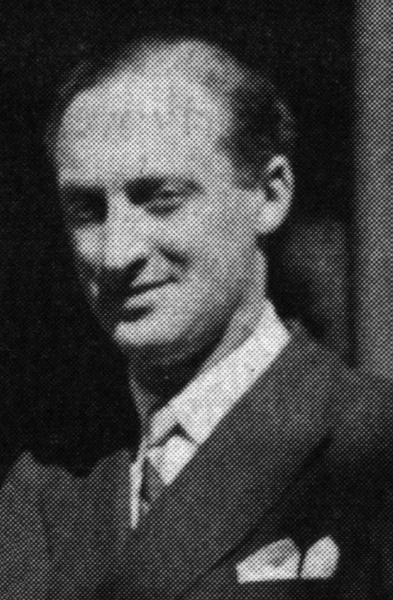


Arved Kurtz was born on June 29, 1899, in St. Petersburg, Russia, the eldest child of a musical family. His brother Efrem would later become an internationally celebrated conductor, his sister Mary a concert violinist, and his brother Edmund a successful cellist and professor of music. Fleeing the October Revolution, the family left St. Petersburg and settled in Berlin, where Arved Kurtz found his first permanent position in the orchestra of the State Opera. Prior to that, the violinist had completed his training in Berlin and Paris and had performed for a time as a chamber musician and soloist. In 1931, he was invited to appear at the Bayreuth Festival for the first time. His second engagement there, in 1933, would also be his last: Arved Kurtz was Jewish.
In December of 1933, he married his fiancée Suzanne in Berlin, who worked as a translator for the liberal Berliner Tageblatt. Shortly thereafter, the couple left Germany. They lived for a time in The Hague under difficult financial circumstances, waiting for a visa to enter the United States. In early 1934, they left the Netherlands to stay with one of Suzanne’s aunts in London. There, in April, Arved Kurtz gave a successful concert at Wigmore Hall. But once their temporary residence permit for England expired, they lived in constant fear of being forced to return to Germany. In August 1934, they were finally able to emigrate to the United States.
Their early days in New York were difficult: Kurtz spoke very little English and struggled to find work. Eventually, he secured a temporary position with the Columbia Broadcasting Company. Soon afterward, through the help of his younger brother Edmund, he was offered a position as head violin instructor at the Elder Conservatory in Adelaide. Kurtz accepted, and he and his wife arrived in Australia in the spring of 1935. Alongside his teaching, he undertook several concert tours across the continent for Australian radio in the years that followed. In 1938, the couple returned to the United States. Arved Kurtz became director—and later president—of the New York Institute of Music and continued to perform in concerts well into old age. He died on March 23, 1995, in New York.
1899 St. Petersburg
1995 New York