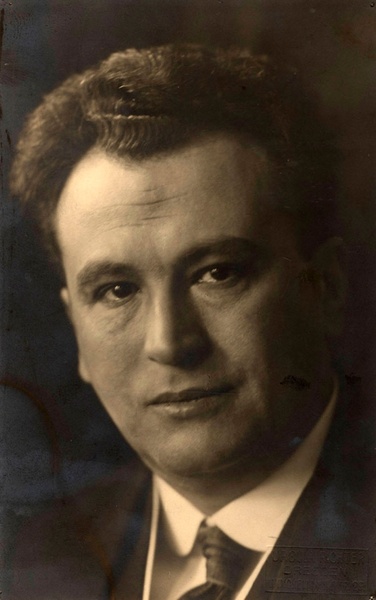


The son of a factory owner, Arthur Chitz was born on September 5, 1882, in Prague. He received his initial training in instrumental performance and composition at a Catholic monastery school. After studying in Prague, Leipzig, and Vienna, he earned his doctorate in music history and began working in Prague as a violinist in the orchestra of the German Theater and as a composer, as well as for a German-language newspaper.
Chitz moved to Dresden in 1908, where he and his family lived in an apartment at Helmholtzstraße 3b. He continued to publish papers on music history while studying chemistry at the Technical University and also made a name for himself as a practical musician, performing as a concert pianist and accompanying renowned singers like Sigrid Arnoldson, a Swedish opera singer whom he accompanied on her international tours. In Dresden, he worked as a lecturer for history and theory at a private music institute.
In 1915/16, he was engaged as a répétiteur at the Dresden Schauspielhaus, where he was promoted as early as 1919/20 to head of stage music and in 1921 to music director of the Staatsschauspiel. In the years that followed, he directed most of the theater’s productions and composed a large number of stage scores, including music for productions of William Tell, Troilus and Cressida, The Merchant of Venice, Julius Caesar, The Maid of Orleans, and The Merry Wives of Windsor. Chitz also composed the scores for the successful Christmas fairy tales Jakob fliegt ins Zauberland and Trill Trall und seine Brüder. Alongside his wide-ranging work at the Schauspielhaus, he also taught at the orchestra school of the Sächsische Staatskapelle until at least 1932.
Firmly established in Dresden’s cultural life, this exceptionally active artist saw his career cut short in 1933, when the Nazis came to power. As a Jew, Arthur Chitz was forced into retirement effective January 1, 1934, and banished from public life. Rather than going into exile, he decided to remain in Dresden, where faced the increasing threat of disenfranchisement and persecution without protection. After the pogroms of November 9/10, 1938, he was arrested as a so-called “Aktionsjude” (action Jew) and detained at the Buchenwald concentration camp from November 10–December 17, 1938. Despite these violent experiences, Chitz and his wife stayed in Dresden, while their children went into exile in the United States in 1938/39.
When Dresden’s Jewish population was forced into so-called “Jewish houses” in 1940, the two vacated their apartment and were subsequently compelled to live in impoverished conditions in a home for elderly Jews at Lothringer Weg 2. On the night of January 20/21, 1942, the two were deported from the Dresden-Neustadt train station to the Riga Ghetto along with a further 224 Jews from Dresden and 561 Jews from Leipzig. Arthur Chitz either died there or was sent to the nearby Kaiserwald concentration camp and died later. His wife Gertrud Helene did not survive her internment either: she died either in Riga or, after being moved from there, during a forced march back toward Dresden.
1882 Prague