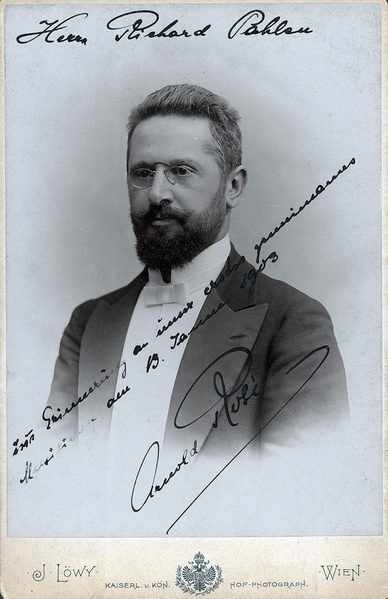


Arnold Rosé was born Arnold Josef Rosenblum in 1863 in what is now Romania. In the late 1860s, his family moved to Vienna. After completing his studies at the conservatory of the Musikverein, he made his debut in 1879 in Leipzig as a member of the Gewandhaus Orchestra. In 1881, he was engaged by the Vienna Hofoper and, at just 17, was soon appointed first concertmaster of both the Hofoper Orchestra and the Vienna Philharmonic. He quickly became something of a sensation and, within a few years, was counted among Vienna’s musical elite. Under the name Arnold Rosé, which he adopted in 1882, he achieved international fame with the Rosé Quartet, which he founded and in which his brother Eduard also briefly performed.
By 1889, the Bayreuth Festival could no longer overlook him and invited him to serve as concertmaster. Yet his role there remained controversial because of his Jewish background, as reflected in repeated debates over his engagement. In 1893, Felix Mottl, a favorite conductor of Cosima Wagner, commented, “Rosé again? Well, in God’s name.” In 1895, it was said, “If Rosé doesn’t come, it’s no great loss. One Jew fewer!” Arnold Rosé made his final appearance in Bayreuth in 1896.
In 1902, he married Justine, the sister of Gustav Mahler. That same year their son Alfred was born, followed by their daughter Alma in 1906. Rosé continued his successful career in Vienna—since 1903 also as a member of the Hofmusikkapelle—until 1938, when it came to an abrupt end. On March 18, he was dismissed from his post at the State Opera with immediate effect, after which he requested retirement. As he later remarked bitterly, he had “sunk into retirement after 57 years at the opera, 56 years with the quartet, and 44 years in the Hofmusikkapelle—without ceremony, without a sound.” In August of 1938, his wife Justine died. After great difficulty, Rosé managed to escape to London the following year. There he was able to perform again, but he spoke little English, depended on financial support from friends, and endured the hardships of German bombing campaigns.
After the war, Rosé’s attempts to obtain compensation were unsuccessful. In August of 1945, he inquired with Austrian authorities about ways to seek redress for the injustice he had suffered. The State Opera proposed reengaging him for an “honorary year” of active service, but he declined and instead requested payment of his pension. He was subsequently informed that it could only be paid into an Austrian account and disbursed within Austria as transfers abroad were not permitted. In the midst of this dispute, Arnold Rosé died on August 25, 1946, in London. His brother Eduard had already perished in 1943 at the Theresienstadt concentration camp, and his daughter Alma was murdered in 1944 at Auschwitz.
1863 Jassy
1946 London