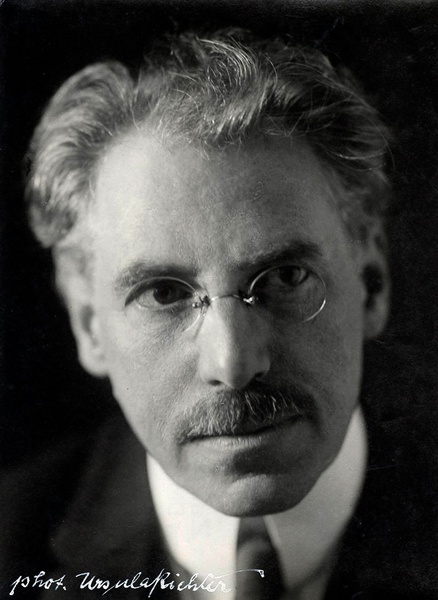


Alfred Reucker was born on March 30, 1868, in Ründeroth, near Cologne, and grew up in Vienna. In 1885, while still a student at a commercial school, he made his debut at a private theater in Vienna. That same year, he joined the municipal theater in Danzig (present-day Gdańsk) as an actor, where he remained for ten years. In 1895, he moved to the Deutsches Landestheater in Prague as an actor, director, and senior stage director, and in 1901 he became director of the Zurich Stadttheater. By the time he left the theater in 1921, he had succeeded in giving it “recognition beyond the borders [of Switzerland].”
Likely for that reason, he was appointed in 1921 to the newly created position of general director of the State Theaters in Dresden. The challenges he faced there were far greater than in Zurich, given the importance of the theaters and the turbulent conditions in Germany marked by civil unrest and inflation. Nevertheless, Reucker succeeded in stabilizing the theaters through sound financial management, consistent ensemble development, and spectacular premieres. His success was aided by his experience; diplomatic skill; friendships with prominent composers; strong professional connections to other German theaters; the trust he enjoyed from successive state governments; and, above all, the close alignment within the top leadership level—marked by mutual respect and confidence. He named his most important collaborators in his 1937 testament: his deputy Hans Reuter; the head of musical preparation Erich Engel; the stage representatives’ spokesperson Paul Paulsen; and Fritz Busch, who, although “quite a handful,” had more than made up for it through his “artistic boldness, his sunny disposition, and his loyalty,” which outweighed everything difficult or troubling.
On March 9, 1933, Reucker was dismissed by the self-appointed general director and long-time ensemble member Alexis Posse, who claimed he had not led the theaters “in a German spirit.” He was forced into retirement on September 1, 1933. In 1934, Propaganda Minister Joseph Goebbels, on the recommendation of Richard Strauss, sought to appoint him president of the Reich Theater Chamber. Reucker later wrote that he resisted the “glittering temptation” of rehabilitation “because of the atrocities with which the Nazi Party had dishonored itself.” Alfred Reucker remained in Dresden and survived the war. He died on December 14, 1958.
1868 Ründeroth (Köln)
1958 Dresden